FBO Fuel Sales: How Pricing, Margin and Visibility Drive Gallons
How FBO fuel sales work: the per-gallon cost stack, contract fuel, margins, 2026 Jet A and avgas prices, and how to get more aircraft to uplift at your ramp.
 Joey Pehrson, commercial pilot, former flight school GM, founderPublished 23 November 2026
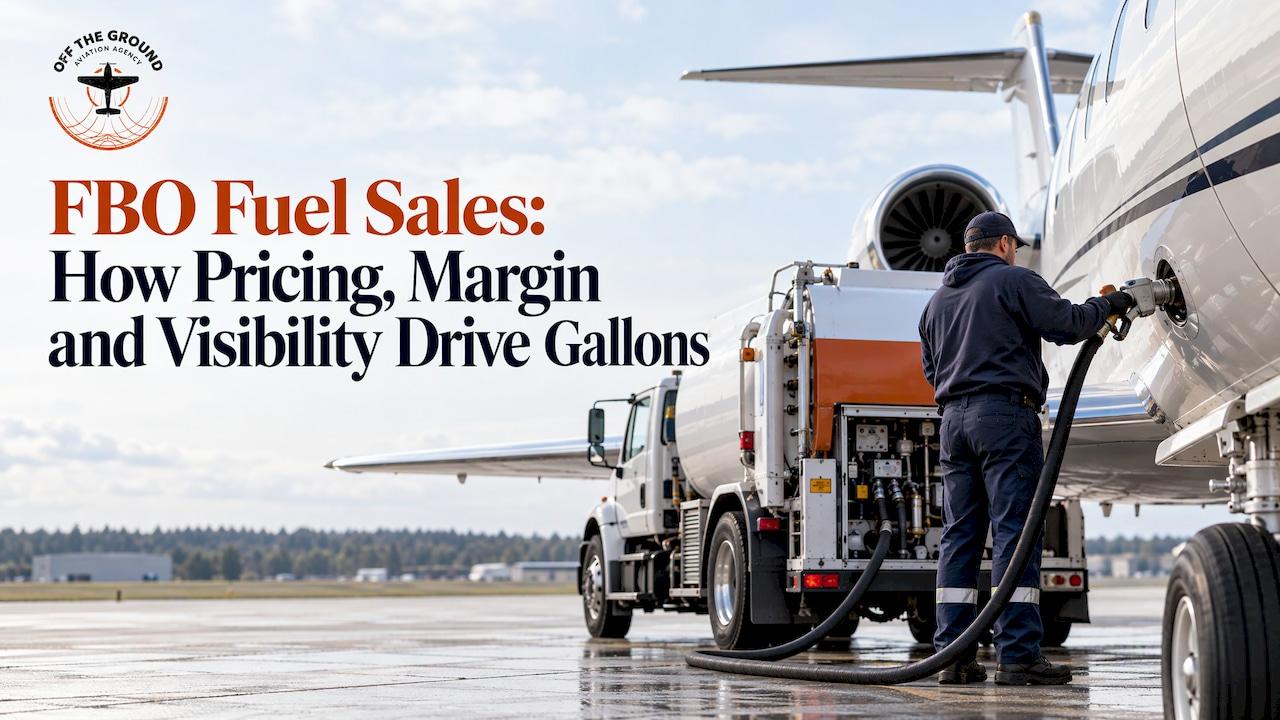
FBO fuel sales come down to one loop: a pilot or dispatcher finds your price, trusts it, lands, and uplifts. Margin per gallon decides what the sale is worth, and visibility decides whether it happens at all. In October 2026, full-service Jet A averaged $8.66 per gallon in the U.S. and full-service 100LL $7.85, both six-month highs. When prices move like that, operators compare more closely, and the FBO with a current, clear, findable price gets the call.
This guide covers how an FBO sells fuel, what sits inside the per-gallon price, how contract fuel and volume discounts work, and how to bring more aircraft to your pumps. It is written for FBO operators, and for charter operators, aircraft managers and brokers who buy fuel at FBOs and want to understand the other side of the counter.
TL;DR
- AOPA reported October 2026 national averages of $8.66 for full-service Jet A and $7.85 for full-service 100LL. These figures are published for that month and move with each monthly release.
- An FBO’s price is a cost stack: product cost, freight, taxes, flowage fees, operating costs and a target margin. Margin per gallon, not raw volume, tells you whether fuel sales are healthy.
- Contract fuel, fuel cards, volume tiers and based-tenant rates are how most large uplifts are priced, so the posted price is only the start.
- Pilots and dispatchers favor FBOs whose current prices and fees are easy to find online, so fuel marketing is a pricing discipline as much as an advertising one.
- Fuel sales grow when search visibility, an accurate website and a simple ordering path work together.
Table of Contents
- How an FBO sells fuel
- What sits inside the per-gallon price
- Reading the 2026 price picture
- Contract fuel, volume tiers and where margin goes
- What actually brings more aircraft to your pumps
- Our perspective
- Where Off the Ground Marketing fits
- FAQ
- Sources
How an FBO sells fuel
The National Air Transportation Association defines a fixed-base operator as a business at an airport that dispenses aviation fuel. The U.S. industry has nearly 3,000 locations, and fuel and maintenance are its two biggest services. Some FBOs also hold fueling contracts with commercial carriers or government entities.
The basic transaction is an uplift: fuel sold into an aircraft. With full-service fueling, FBO staff drive a truck to the aircraft, dispense the fuel and collect payment, so the pilot does not need to be involved and the aircraft does not need to move. Self-service is the lower-priced alternative at many airports, mostly for avgas.
Payment arrives in a few ways:
- Direct payment: credit card or cash at the counter.
- Fuel cards: a contract fuel card from a supplier network, verified electronically at the pump or desk.
- Releases and throughput: a broker or supplier authorizes the uplift and settles with the FBO afterward.
For a charter operator or broker, the card or release is usually how you buy. For the FBO, each method has a different margin, which is why the mix of customers matters as much as the gallon count.
What sits inside the per-gallon price
FBO fuel pricing is built bottom-up. Trade coverage of FBO refueling management notes that a retail fuel agreement may be indexed to the weekly average of the Platts Index plus a fixed differential, resetting every Tuesday. On top of product cost come $0.244 per gallon in federal taxes, a $0.002 per gallon LUST fee, state and local taxes, transportation, and airport fuel flowage fees.
Then the FBO adds what it costs to run the operation: trucks, the fuel farm, quality-control testing, line staff and insurance, plus a margin.
A public airport formula
Public airports sometimes publish the formula. The Lee County Port Authority’s FY2027 rates for Page Field (fiscal year October 1, 2026 to September 30, 2027) set Jet A full-service retail at cost of goods plus $2.67 per gallon. That adder breaks down into $1.37 operating expenses, $0.88 margin and $0.42 airfield cost recovery. Full-service avgas is cost plus $2.07, self-service avgas is $1.10 per gallon lower, and a $0.42 per gallon flowage fee applies to tenant self-fueling.

As an illustration only: if an FBO’s delivered cost were $6.00 per gallon, that Jet A formula would produce a retail price of $8.67. The cost moves with the market. The adder is the part you control.
Why prices differ between airports
The U.S. Government Accountability Office found that FBO prices reflect facility and operating costs, demand (seasonal ski-resort traffic is its example) and competition. Its model found higher prices at higher-cost, higher-demand airports, and lower fuel prices at the busiest airports with more than one FBO. Location, in other words, shapes price long before your marketing does.
The spread is visible in dated listings. In October 2026, New England and Eastern regions averaged $9.11 and $9.03 for Jet A, and Alaska and Hawaii approached $10. GlobalAir’s September 2026 national Jet A average of $7.99 was the third record high of the year. Different trackers survey different FBOs, so their numbers differ by a few cents. They agree on the direction.

Reading the 2026 price picture
The AOPA figures give a clean headline. Between February and October 2026, national full-service Jet A rose 35.1% and 100LL rose 22.1%, while self-service 100LL averaged $6.82 in October. The figures come from iFlightPlanner’s monthly fuel price report, so expect a new set each month. Fuel prices follow the crude and refined product markets, and the monthly averages lag them.
What does that mean for an FBO? Three things:
- Inventory is expensive. A fuel load can cost up to $40,000 or more, and two 20,000-gallon tanks can tie up over $100,000 in inventory. Rising prices raise the cash you need to stay stocked.
- Buyers shop harder. When Jet A is up a third in eight months, a dispatcher checking three airports on a trip will notice a 30-cent gap.
- Your posted price becomes your first sales pitch. It is usually the first thing a pilot sees, so it has to be accurate.
AirNav listings show how real FBOs present this. A Maine FBO listed in November 2026 posts $9.15 Jet A and $7.75 100LL full-service, with Jet A volume discounts of 20 to 35 cents per gallon for 350+ gallon purchases. A Montana FBO listed that month shows $8.35 Jet A with tiered discounts of 5 to 25 cents per gallon from 200 gallons, and lists the fuel cards it accepts. The posted price, the tiers and the accepted cards are all information a buyer uses before landing.
Contract fuel, volume tiers and where margin goes
Most charter and corporate uplifts do not pay the posted retail price. With contract fuel, the operator buys at negotiated prices across an FBO network through the supplier’s fuel card. The supplier earns the spread between what the operator pays and what the FBO receives, and the FBO earns a per-gallon margin for moving volume.
So each customer type carries a different margin:
| Customer type | How they usually pay | What it means for the FBO |
|---|---|---|
| Transient piston pilot | Posted retail, full or self-service | Highest per-gallon margin, small uplifts |
| Based tenant | Tenant pricing, sometimes with fee waivers | Steady volume, thinner margin |
| Charter or corporate flight | Contract fuel card or release | Large uplifts, negotiated margin |
| Government or airline contract | Contract terms | Volume anchor, lowest margin |
The pricing structures FBOs offer typically include posted retail, contract fuel, volume discounts, based-tenant pricing, fee waivers and lower self-service prices. Fee waivers deserve attention: a ramp or handling fee that disappears with a minimum uplift changes the real cost of a stop more than a few cents off the fuel price.
Other industries face the same question of how a surcharge or fee should be itemized and discounted. A walkthrough of how fuel surcharge pricing models work shows why buyers trust a quote more when each component is visible.
Protect margin when you match a competitor
The ABSG consultants writing in AC-U-KWIK ALERT argue that managing the refueling business is the secret to a successful FBO. Watch indexed margins, buy when the Platts Index is falling, and avoid chasing deep-discount competitors, because high cash flow from volume can mask a deteriorating margin. Fuel sales pay for payroll, benefits, facility upkeep and insurance, so a margin that slips by a few cents on every gallon shows up everywhere else.
What actually brings more aircraft to your pumps
A price war is the obvious lever and usually the weakest one. It only works if the extra volume covers the lower margin. The levers that last are less dramatic:
- Keep your price current and public. AOPA reported that iFlightPlanner’s Andy Matthews said pilots seem to pay attention to how recently prices were updated, and when airport prices vary little, seem to choose the airport with the more current price. iFlightPlanner has not studied that statistically, but it matches how trip planning works.
- Post fees, not just fuel. The GAO notes the industry’s Know Before You Go campaign pushes FBOs to post fees online. A buyer comparing two airports is comparing the whole visit: fuel, ramp, handling and overnight.
- Make ordering ahead easy. A form, a phone number that gets answered and a dispatcher-friendly page let your line staff plan for an arrival instead of reacting to one.
- Show up where the search happens. Dispatchers and pilots search by airport and by service. If your listing, map profile and website do not answer “who fuels here and at what price,” someone else’s will.
That last point is where marketing meets fuel sales. Our guide to FBO marketing strategy for fuel sales and dispatcher capture covers how to reach the people who choose a fuel stop. If you want the search side in detail, read SEO for FBOs, and for the site itself, FBO website design shows what a pilot needs to see before calling.
A simple weekly fuel-visibility routine
- Check your posted Jet A and avgas prices against your actual pump price every Monday, and again after your index-based cost resets on Tuesday.
- Confirm your fees, waivers and volume tiers on your website match the front desk’s answer.
- Review your Google Business Profile and listing hours, phone number and fuel types.
- Look at which airports a typical customer would compare you with, and check how your whole-visit cost reads next to theirs.
- Note which inquiries came from search, from cards and from repeat customers, so you know which customer type is growing.
The point of step five is to measure demand for your brand, not just gallons. Gallons can rise while the share from high-margin customers falls.
Our perspective
Fuel is the product everyone at an airport can see, so it is also the product most easily commoditized. When two FBOs sit within a few cents of each other, the buyer chooses on information: a price that is current, a fee schedule that is clear, and a way to order that does not need three phone calls.
I came to marketing from the cockpit and from running a flight school’s operations, so I think about the buyer’s side first. A pilot or a charter dispatcher planning a leg is not browsing. They are comparing stops against a schedule, and they reward the operator whose answer is easy to find.
That is why we build FBO marketing around how those buyers behave: search visibility that matches how they look for fuel and handling, a website that states the price and the process plainly, and measurement that tracks brand demand rather than vanity traffic. Fuel sales are won in the minutes before the aircraft lands, and the work happens well before that.
Joey Pehrson
Where Off the Ground Marketing fits
Off The Ground Marketing is an aviation-only practice. We run SEO, websites, PPC and lead generation for aviation businesses, FBOs among them, and our founder is a commercial pilot and former flight school general manager. Published pricing starts with Aviation SEO from $1,500 per month and the Launch Pad plan at $1,500 per month, with higher tiers up to Flight Director from $8,500 per month on our pricing page. Extra locations, with a Google Business Profile and local SEO, are $400 per month each.

For an FBO, that means search visibility for fuel and handling queries, a site that states what a pilot needs, and PPC where it pays back. See how we approach it in FBO marketing for fuel stops and hangar demand or go straight to our FBO SEO service.
FAQ
What does FBO fuel sales mean?
It is the revenue an FBO earns by selling Jet A and avgas into aircraft, either through full-service uplifts or self-service pumps. Most FBOs also earn from hangars, handling, maintenance and other services, but fuel is one of the top two services in the industry.
How do FBOs set the price of Jet A and avgas?
They start with product cost tied to a market index, then add freight, taxes, flowage fees, operating costs and a target margin. Airports that publish formulas, such as Lee County’s, show the adder as a fixed amount per gallon over cost. Competition and demand at the airport then push the final price up or down.
How much did aviation fuel cost in 2026?
AOPA reported October 2026 national averages of $8.66 for full-service Jet A and $7.85 for full-service 100LL, with self-service 100LL at $6.82. Different surveys land a few cents apart, and regional averages can run well above or below the national figure. Check the live tables for the current month.
How can an FBO sell more fuel without cutting margin?
Keep prices and fees current online, make ordering ahead simple, and make sure your airport appears when pilots and dispatchers search. A price cut only pays when the added volume covers the lower margin per gallon.
Sources
- Making every gallon count, AOPA
- Get to Know FBOs, National Air Transportation Association
- AirNav: Fuel Service
- FBO Refueling Management: Your Bottom-Line Anchor, AC-U-KWIK ALERT
- Page Field (FMY) Rates and Fees, Fiscal Year 2027
- Airports: Information on Prices for Aviation Services, GAO-20-16
- Avgas Hits Six-Month High as U.S. Fuel Costs Rise Again, G&B Daily News
- Aviation Fuel Spotlight, GlobalAir
- AirNav: Modern Aviation at Hancock County/Bar Harbor Airport
- AirNav: Minuteman Jet Center at Missoula Montana Airport
- Understanding Contract Fuel Cards and How They Work at FBOs, FBO Director
- How FBOs price fuel: costs, margins and pricing strategies
- Fuel surcharge calculation and pricing models
Recommended
Aviation Marketing Notes
One operator-shaped read per week. No agency newsletter padding.
We share the patterns we see across flight school, charter, MRO, and FBO clients. Practical. Aviation-specific. Unsubscribe whenever.