
Enterprise Drone Contracts Are Lost Before Ops Even Talk
Compliance review, insurance checks, vendor qualification — the three gates enterprise drone operators answer before the RFI stalls, built as a search system.
Watch on YouTube ->We help commercial UAV operators turn Part 107 / ReOC compliance and field deliverables into clearer positioning and stronger visibility.
A Pacific Northwest flight school and FBOA UK flight schoolA North American charter operatorProposal in 48 hours
Built for commercial drone operators selling inspection, survey, and asset-data outcomes to enterprise customers who verify safety, compliance, sample report quality, and vendor-qualification evidence before they request scope.
Typical starting point: marketing from $1,500 USD/month and websites from $3,500 USD. Scope changes by market and service mix. Every engagement is scoped to your operation — no packaged plans.
Results
Part 107 + BVLOS-fluent page architecture
Enterprise drone buyers move when the page proves the deliverable, safety process, Part 107 / BVLOS / ReOC fluency, insurance, and vertical fit before procurement asks for scope.
01
Outcome-led search
02
Vertical proof
03
Compliance and insurance
04
Scoped RFQ capture
Quick answer
Talking about the aircraft first instead of the business outcome, compliance confidence, and vertical-specific value. Enterprise customers care about deliverables — volumetric reports, thermal anomaly detection, orthomosaic accuracy — not sensor specs or flight time. A drone company website that leads with airframes rather than outcomes loses credibility with procurement teams who are comparing you against traditional inspection or survey vendors, not other drone operators.
Fit check
Right fit
Not the right fit if…
Win more inspection and survey RFQs
Show up for searches around inspections, mapping, thermal, LiDAR, and asset intelligence instead of generic drone traffic.
Prove sector fit fast
Make it obvious which assets, industries, and deliverables you handle so utilities, construction, energy, and industrial customers can self-qualify quickly.
Reduce compliance and delivery risk
Surface Part 107 / ReOC approvals, BVLOS or LAANC / COA capability, insurance, pilot and inspector credentials, and sample outputs so procurement teams trust the operation before the first call.
Terms mapped from regulator manuals and live buyer search demand
Terms mapped from regulator manuals and live buyer search demand
Proposal within 48 hours — across all sectors
Where operators usually start
Most commercial drone operators bring us in when the site attracts vague traffic, proposals are doing too much of the selling, or growth.
Own the searches serious customers make when they need drone inspections, mapping, thermal work, LiDAR capture, or recurring asset surveys.
Best when traffic exists but too little of it turns into real RFQs from asset owners, engineers, or procurement.
Build separate proof for each priority vertical so a utility, solar, construction, mining, or energy customer sees relevant jobs, deliverables, field context, sample report packs, and vendor-qualification evidence immediately.
Best when one generic homepage is trying to speak to every industry and none of them feel fully understood.
Support search-led demand with paid and retargeting around priority services so growth does not depend entirely on word of mouth, tender luck, or outbound.
Best when the business has capability but lead flow is inconsistent quarter to quarter.
Video explainers
Short explainers on how buyer intent turns into enquiries, quote requests, and RFQs.
Compliance review, insurance checks, vendor qualification — the three gates enterprise drone operators answer before the RFI stalls, built as a search system.
Watch on YouTube ->What drives growth
Serious customers are not shopping for drones.
Visibility
Customers search for pipeline inspection, flare stack inspection, thermal survey, stockpile measurement, roof inspection, or LiDAR mapping, not just drone company.
Proof
They look for matching asset types, case studies, and sample outputs that prove you can work in their environment.
Compliance
They want regulatory approval, insurance, safety process, airspace competence, and any technical credentials relevant to the work before a procurement or EH&S team will add the operator to the vendor list.
Conversion
A serious customer wants to submit asset type, location, deliverables, frequency, and timeline without a generic contact form.
Worldwide service area
We work remotely with commercial aviation teams worldwide. Australia, the United States, the United Kingdom, Canada, and New Zealand have dedicated pages — everywhere else starts on the global aviation-marketing route.
Drone services marketing is the practice of generating enterprise contracts and qualified commercial enquiries for UAV operators, aerial survey companies, inspection specialists, and drone-as-a-service providers. The majority of drone companies market capabilities rather than outcomes — which produces hobbyist traffic instead of the commercial contracts that justify operational investment. What the enterprise tier evaluates:
Enterprise customers have established evaluation criteria for UAV providers, and procurement teams need a vendor-qualification pack before an RFQ can move. Demonstrating regulatory fluency is one of the fastest ways to establish credibility with the enterprise buyers who require it before they will engage.
What we fix

Photo: Rodolfo Baumann / Pexels
Enterprise procurement is gatekept by EH&S and legal before an ops team ever talks to you. Without visible Part 107 certification, BVLOS waiver history, and aviation hull and liability coverage on the site, most RFIs stall at the vendor-qualification step — and you never find out why.
Prospective customers care about outcomes, compliance, and industry fit, but your site talks mostly about equipment. A utility procurement team comparing you against a $400/hr fixed-wing aerial-survey incumbent never sees the unit economics advantage because the page leads with airframes instead of NERC-grade transmission reports or IR hotspot logs.
Leads are inconsistent because search, case studies, and landing pages are not aligned to vertical use cases. Telecom tower, T&D lines, solar farm, wind blade, and industrial-refinery customers each want their own vocabulary, sensor pages (RGB / thermal / LiDAR / multispectral), sample report packs, and deliverable specificity — not a shared "drone inspection" page.
Why Off The Ground
Messaging built around named verticals (telecom, utility T&D, wind, solar, industrial-refinery) and the deliverables enterprise procurement actually verifies — not generic "drone capability".
Search strategy tuned to Part 107 + BVLOS + ReOC + vertical-specific queries rather than broad drone vanity terms.
Landing pages designed for inspection, survey, media, and industrial demand paths with sensor-aware content (RGB / thermal / LiDAR / multispectral) the procurement team can match against the RFI scope.
RFQ and vendor-qualification paths that collect asset type, airspace constraints, deliverable format, inspection frequency, insurance requirements, and sample-report expectations before the first call.
Next Step
Need a sharper plan to win more commercial drone scope requests?
We will review how customers are finding you, where sector proof or compliance confidence is breaking down, and what to fix first.
Request your proposal →Part 107 + BVLOS-fluent page architecture
Drone services marketing is best anchored on named vertical depth (telecom tower, utility T&D, wind blade, solar farm, industrial-refinery) with sensor-aware content. Proof on this page is capability-led. /drone-inspection-marketing has the verticals-and-sensors detail an enterprise UAV ops lead expects.
Case studies
Real engagements, real numbers — identities withheld by vertical where client confidentiality applies.
Inside the stack
You do not need to buy these one by one. These pages break down the SEO, website, content, and Google Ads work that usually sits underneath a stronger enterprise UAV lead engine.
Sub-sectors
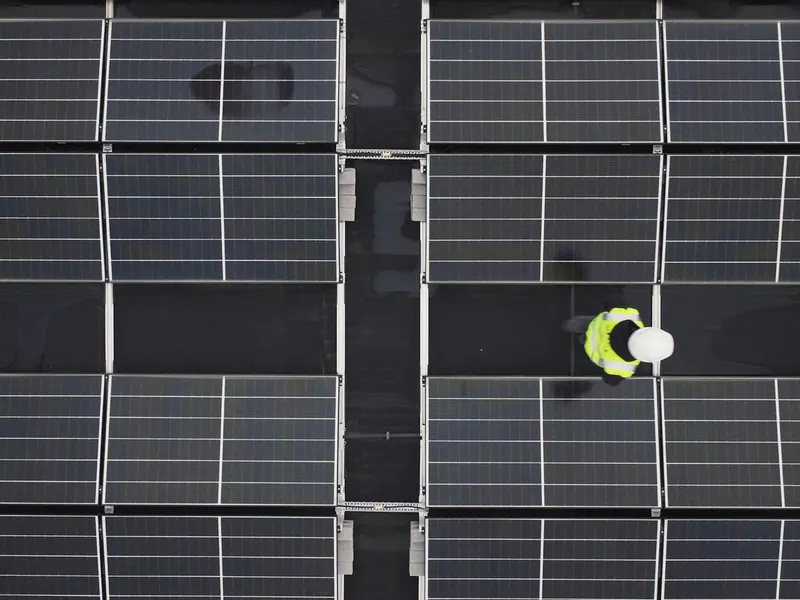
Inspection customers need pages tied to asset classes, reporting outcomes, and enterprise trust signals rather than generic drone capability language.
Surveying demand sits on different terms, project questions, and proof requirements than broader media or hobbyist drone work.
DaaS and managed drone programme customers evaluate subscription models, SLA structures, and total cost of ownership rather than per-mission pricing.
Ready when you are
Written plan, scope, and pricing by email. No discovery call required.
Also from this page: Request Proposal → · AI Visibility Audit ($497) →
Frequently Asked Questions
Specialise visibly. The most common positioning mistake is serving every industry from a single homepage. Pick two or three verticals where you have the strongest case studies, regulatory approvals, and operational depth, then build content clusters around each. A drone operator with five detailed mining inspection case studies and content on CASA Part 101 compliance for BVLOS operations will outrank and outconvert a generalist competitor every time. The website should make immediately obvious which industries you serve best.
At minimum, your site should demonstrate familiarity with the regulatory framework in your operating market: CASA Part 101 and ReOC requirements in Australia, FAA Part 107 and COA processes in the US, CAA PfCO and operational authorisations in the UK. Not just compliance but a trust signal: enterprise customers and government procurement teams verify regulatory awareness before shortlisting vendors. Pages referencing specific approvals, BVLOS capabilities, and airspace management experience convert better than those treating regulation as an afterthought.
OTGM commercial-drone retainers follow the public tier structure: $1,500 USD/month for foundational SEO and content, $3,000 for a broader organic and paid mix, and $5,500 for higher-output content and multi-platform campaigns. Ad spend and website work are separate. Choose the smallest tier that can test one named vertical and measure cost per qualified opportunity; expand only after the enquiries match the operator’s capability, geography, and contract economics.
Paid campaigns for project bids can generate enquiries quickly; SEO for service-area and vertical terms usually shows measurable movement within three to five months. Reporting runs monthly on Launch Pad, fortnightly on Altitude, weekly on Glass Cockpit — tracked in qualified enquiries, not impressions. Everything starts with a written proposal in your inbox within 48 hours.
Tenders close the contract, but procurement teams still check you online — credentials, ReOC or Part 107 standing, BVLOS approvals, and past project proof. Marketing by an aviation-only team surfaces those credentials so you stay in the vendor-qualification pile before the tender is issued. That is the gap most drone operators leave open.
Still deciding? Get a tailored Drone Services Marketing proposal in 48 hours →
Depth beyond this page
Guides you can check before you enquire — compliance systems, geo targeting, performance standards, and the results pages behind the claims.
Ready To Grow?
We will map the search, proof, and enquiry gaps holding back higher-value inspection, survey, and mapping work.


