Audit-defensible CBTA mapping for flight training operators — in days, not months.
Lesson-to-MOS mapping, per-student rubrics, course rollups, qualification-level coverage. Fixed-fee. Instructor-signed defensibility. Delivered in five to ten business days.
Built for AU operators under CASR Part 141 and Part 142. RTO overlay available for organisations also delivering AVI training package qualifications. The CBTA Pack sits inside the broader OTGM Compliance Practice.
What you get
- · Planning Matrix mapping every lesson to Part 61 MOS units of competency
- · Lesson Plans and Training Records (single-document format)
- · Per-student rubric framework, operator-configurable
- · Course-level and qualification-level coverage rollups
- · (Optional) RTO overlay — AVI training package cross-mapping
- · (Optional) Audit Defence Pack — signed mapping declaration in inspector-readable order, aligned to CASA Surveillance Manual Annex 21
Quick answer
What is the Audit-Defensible CBTA Pack?
A fixed-fee consulting engagement that produces a complete Part 61 MOS competency mapping pack — lesson-to-MOS-unit Planning Matrix, lesson plans and training records, per-student rubric framework, and course-and-qualification-level coverage rollups — for CASR Part 141 (non-integrated) and Part 142 (integrated) flight training operators in Australia. Aligned to AC 61-09 CBTA principles and CASA Surveillance Manual Annex 21. Delivered in five to ten business days, signed by an instructor, audit-ready for the next CASA Surveillance event.
The pain
When CASA Surveillance arrives, they go through your training records with a fine-toothed comb.
Lesson plans, Part 61 MOS units of competency coverage, per-student rubrics, lesson-to-licence mapping. If anything is loose, the surveillance event slows down. If a competency is missing, the conversation gets uncomfortable. The work to keep that audit-defensible takes weeks per cohort. The artefacts surveillance reviewers actually use are published in CASA Surveillance Manual Annex 21 — the Part 141 / 142 flight training activities annex. We build to that.
Part 141 (non-integrated) and Part 142 (integrated, MPL, contracted recurrent training) operators carry different documentation surfaces. A Part 141 school maps to an Operations Manual structure. A Part 142 operator maps to an Exposition structure with a Head of Training and Checking sign-off path. We ship the right artefact for your Part.
Most schools run mapping on spreadsheets. Some hire bespoke aviation consultants and wait months for a quote with no public pricing. CASA gives you free tools — the Manual Authoring and Assessment Tool (MAAT), sample syllabuses for Part 141 / 142, and the AC 61-09 Competency-Based Training and Assessment Advisory Circular — but the labour to populate them with mapped, defensible content is the constraint.
AU flight training organisations all deal with this. The smaller subset that are also RTO-certified deal with a second mapping layer on top — cross-walking each Part 61 MOS unit into AVI training package elements (Performance Evidence, Knowledge Evidence, Performance Criteria) under the ASQA 2025 Standards for RTOs.
How the mapping pyramid works
Three layers of work, every cohort.
Take Lesson 1 — Effects of Controls. It carries roughly a hundred CASA competency elements that have to be linked to it, scored against each student through the lesson series, and rolled up to course and qualification level. Multiply that across every lesson, every student, every course you deliver.
Layer 1
Lesson competency mapping
Every lesson plan mapped to its full Part 61 MOS units of competency — element, performance criteria, range of variables, underpinning knowledge. Per-student rubric scoring on top. Aligned to AC 61-09 CBTA principles.
Layer 2
Course competency rollup
Lesson coverage rolled up to course-level completion. PPL course, CPL course, Instrument Rating course, Flight Instructor Rating — each course's complete competency surface, ready for audit.
Layer 3
Qualification competency rollup
Course coverage rolled up to the final standards required for licence or rating issue. The artefact a CASA Flight Examiner expects to see when signing off proficiency.
For RTO-certified schools
A fourth layer.
About fifteen of Australia's eighty-or-so CASA-certified flight schools are also RTO-certified — delivering AVI training package qualifications under the ASQA Standards. If that is you, the mapping has a fourth layer:
Each CASA competency tick-off propagates to the corresponding AVI training package element — Performance Evidence, Knowledge Evidence, Performance Criteria — so a single completed assessment satisfies both regulators.
We add this as Tier 3 on any mapping sprint. Fixed-fee, per AVI qualification mapped.
How we do it
AI compresses the data assembly. An instructor signs the defensibility.
I spent months building this kind of mapping pack manually for a previous employer. With AI on the inside, the data-assembly work that used to fill weeks now fills days. The judgment work — calibrating rubrics, resolving operator-specific edge cases, defending the mapping in an actual inspection — still lives with a commercial pilot and Grade 2 flight instructor.
AI does the heavy lifting
- Parses MOS units, elements, performance criteria, range of variables, underpinning knowledge into structured form
- Semantic-matches every lesson against the right MOS competencies
- Flags Knowledge Evidence and Performance Evidence gaps per unit (Tier 3 only)
- Generates first-draft Planning Matrix and lesson plans
- Surfaces ROV items not covered anywhere in the lesson library
- Detects ambiguous performance-criteria phrasing across lessons
An instructor signs the defensibility
- Reasonableness check on every AI mapping — does it actually fly?
- Operator-specific rubric design (your 3/2/1 scale or whatever your house style is)
- Instructor-to-instructor consistency calibration
- Aircraft-specific and sim-vs-aircraft edge cases
- Negotiating which lessons stretch across multiple competencies vs splitting
- The signed declaration that an inspector can read in five seconds
Timeline
- Day 0: intake call · materials request
- Days 1-3: AI-accelerated data assembly
- Days 3-5: instructor review · calibration · sign-off
- Day 5-7: handover call · artefacts delivered
What you get
An audit-defensible pack. Not a spreadsheet you have to defend yourself.
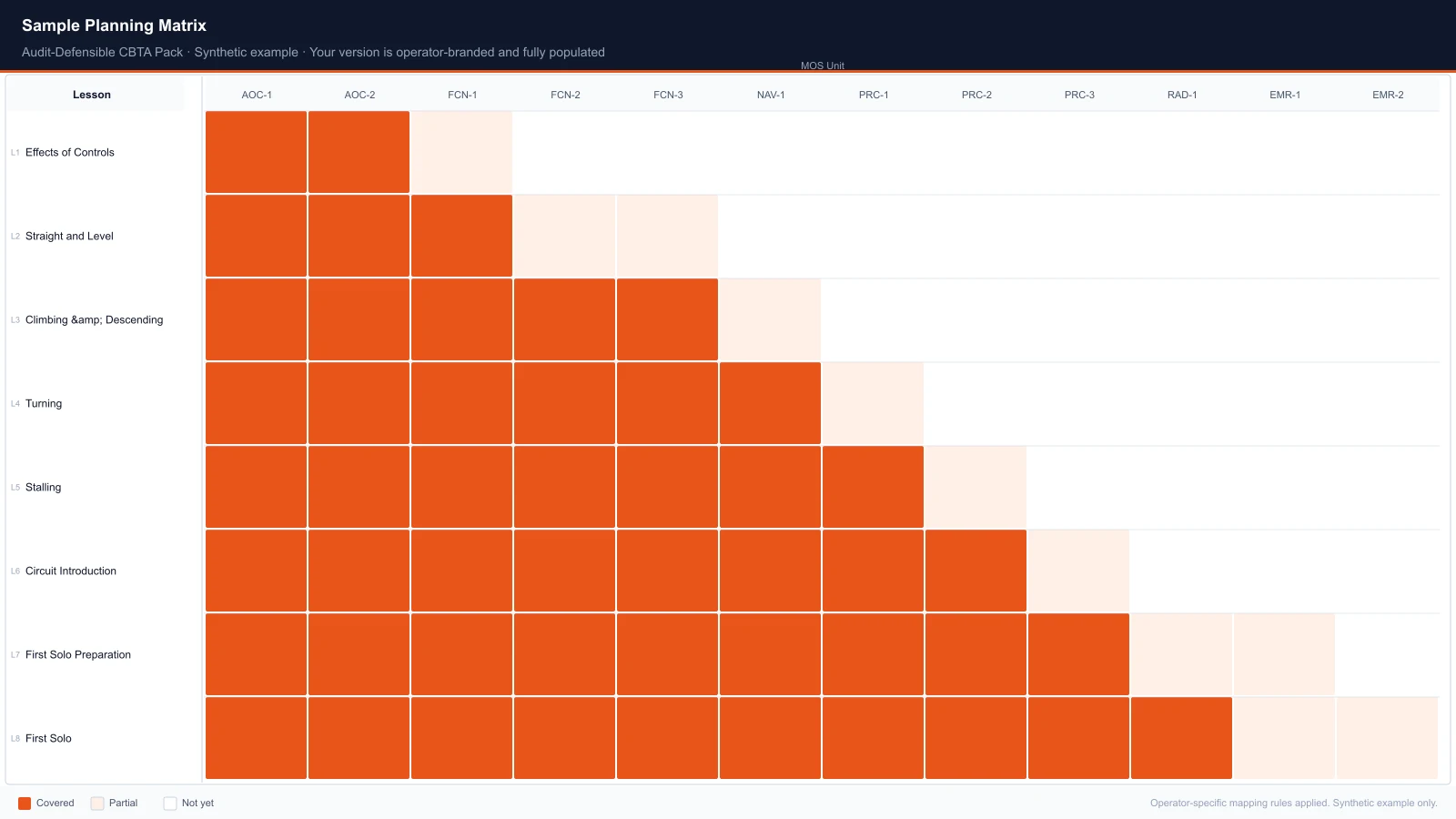
Planning Matrix
Lesson-by-lesson rows against MOS unit and element columns. The artefact the CASA Guide to the Use of CASA Flight Training Syllabuses describes — populated, mapped, defensible.
Lesson Plans and Training Records
Single-document format per CASA guidance: overview, briefing topics, underpinning knowledge, performance criteria, recording mechanism, debriefing checklist.
Per-student rubric framework
Configurable scale — your house standard, not ours. The CASA C / Not Yet Competent binary remains untouched at the outcome level; the rubric runs underneath for progression tracking.
Course + qualification rollups
Aggregate coverage per course and per licence or rating. The artefact a Flight Examiner reads when signing proficiency.
Coverage diagnostic
A flagged list of MOS elements not currently covered anywhere in your lesson library. Find the holes before CASA does.
Handover briefing + 30-day cover
Thirty-minute walkthrough call with your CFI or Head of Operations. Thirty days of small-fix amendment cover post-delivery, included in every tier.
Sample preview
What a Planning Matrix looks like
Synthetic example. Your delivered version is operator-branded and fully populated with your lessons and MOS units.
Packages + pricing
Fixed fee. Anchored to scope, not your panic.
Every tier includes the Planning Matrix, lesson plans, rubric framework, coverage diagnostic, handover briefing, and thirty-day amendment cover. Tier choice depends on how many licences or ratings you're mapping and whether you also need the AVI training package overlay.
Tier 1
Mapping Sprint
Single licence or rating.
from AUD $3,500
- One licence: PPL, CPL, IR or FIR
- Planning Matrix + lesson plans
- Per-student rubric template
- Coverage diagnostic
- 5-7 business day delivery
Tier 2 · most popular
Multi-Licence Sprint
Two or more licences or ratings.
from AUD $7,500
- Everything in Tier 1, multiplied
- Cross-licence coverage map
- 7-10 business day delivery
Tier 3 · add-on
RTO Overlay
For RTO-certified schools only.
+AUD $2,500
per AVI qualification mapped
- CASA → AVI cross-mapping
- Performance Evidence / Knowledge Evidence / Performance Criteria coverage
- TAS alignment notes
- Adds 3-5 days per qualification
Tier 4
Enterprise
School-wide.
from AUD $15,000
- All licences and ratings
- Audit-prep wrapper · mock-inspection call
- Audit Defence Pack included
- 3-6 month minor-amendment cover
- 10-15 business day delivery
Need it faster? Rush turnaround (five business days or less) is +25 percent across all tiers. Audit Defence Pack add-on for Tiers 1-3 is +AUD $1,500.
Frequently asked
Questions that come up before you enquire.
Bespoke aviation consultants typically work on a phone-quote, multi-month engagement model. We work on a fixed-fee, five-to-ten-business-day delivery model with public pricing. The deliverables are similar; the speed, transparency and cost profile are not.
Your current syllabus or lesson library (CASA samples, custom or inherited — any shape), licence or rating scope, your operator-specific assessment rules (rubric scale, instructor sign-off chain), and your instructor list with qualifications. RTO-certified schools also send the scope of registration and target AVI qualifications.
AI does the data-assembly work: parsing MOS units into structured form, semantic-matching lessons against competencies, drafting Planning Matrix rows, flagging coverage gaps. An instructor reviews every output, calibrates the rubric, resolves edge cases and signs the defensibility declaration. You receive instructor-signed work, with AI acceleration on the inside.
Tier 2 or Tier 4 fits better than Tier 1 because Part 142 operators carry integrated-course MOS coverage, a quality assurance manager, and a professional development program. The pack includes the artefacts your HOTC needs for CASA Surveillance Manager review and for instructor consistency calibration across the team.
Add Tier 3 RTO Overlay to any sprint. You receive a cross-mapping document linking each Part 61 MOS unit of competency to the corresponding AVI training package element — Performance Evidence, Knowledge Evidence, Performance Criteria — plus Training and Assessment Strategy (TAS) alignment notes flagging where your TAS needs amendment under the 2025 Standards for RTOs. Common AVI qualifications mapped: AVI50219 (Diploma of Aviation — CPL Aeroplane), the AVI50319 / AVI50222 / AVI50322 newer CPL revisions, AVI50419 (Diploma of Aviation — Flight Instructor), AVI50519 (Diploma of Aviation — Instrument Rating), and AVI40120 (Certificate IV in Aviation — Aviation Supervision). If you deliver a superseded version (e.g. AVI40219), we map to that version and flag the upgrade path.
Defensibility is the design goal, not a side effect. Every artefact is signed by Joey Pehrson — commercial pilot, Grade 2 flight instructor — and assembled in inspector-readable order, aligned to CASA Surveillance Manual Annex 21 (the Part 141 / 142 flight training activities annex CASA surveillance staff actually work from). The optional Audit Defence Pack adds a single PDF and signed mapping declaration designed for hand-over at the start of a CASA Surveillance event.
You get thirty days of small-fix amendment cover in every tier. CASA-published amendments inside that window are folded in at no extra cost. Outside the window, an amendment pass is quoted separately based on scope. Tier 4 includes a longer three-to-six month amendment cover.
Yes. The Part 61 MOS schedules are separate for helicopter and aeroplane categories, so each is priced as its own Tier 1 if you only need one, or rolled into a Tier 2 or Tier 4 if you operate both. Joey is rotary-rated, so helicopter syllabus context is native, not learned in the engagement.
Yes. The pack is delivered in editable formats with your operator branding on every artefact. Internal sign-off chains remain yours.
Intake call within two business days of enquiry. Tier 1 delivery in five to seven business days after intake. Tier 2 in seven to ten. Tier 3 adds three to five days per AVI qualification. Tier 4 runs ten to fifteen days. Rush turnaround (five business days inclusive of intake) is +25 percent.
Get a fixed-fee quote
Send the operator details. We will reply within one business day.
Tier recommendation, fixed-fee scope, and a thirty-minute intake call slot. Or use the longer /contact form if you want to chat first.
About
Built by the instructor who did this work by hand for months.
Joey Pehrson is a commercial helicopter pilot and Grade 2 flight instructor based in Brisbane. Off The Ground Marketing started as an aviation-only marketing agency after he watched generalist agencies butcher flight-school campaigns. The Audit-Defensible CBTA Pack started as a manual mapping job for a previous employer that took months.
The AI workflow that compresses that work into days is the wedge. The defensibility signature is the moat.
See the full OTGM Compliance Practice — the CBTA Pack sits alongside the CASA Documentation Pack and the RTO Overlay, all instructor-signed. See the flight-school marketing service if marketing is the bigger pain. Use /contact for anything else aviation-related.
Most CBTA Pack customers also need the CASA Documentation Pack — the 2 December 2026 SMS mandate hits the same Part 141 / 142 operators. Take the 7-question SMS readiness check →