
Flight school marketing that turns interest into discovery flights and student starts.
We help flight schools fill more discovery flights and turn more of those flights into enrolled students.
Led by a commercial pilot and former general manager of a flight school who has personally answered the discovery-flight phone and knows how those calls become enrolled students.
Typical starting point: marketing from $1,500 USD/month and websites from $3,500 USD. Scope changes by market and service mix.
Quick answer
What matters most for flight school SEO?
Location pages, training-pathway content, discovery-flight conversion pages, instructor credibility, and strong local search signals are the foundation. Depth beats breadth: a school with detailed pages for each licence pathway (RPL, PPL, CPL, instrument rating, instructor rating) outranks one generic training page every time. Google rewards topical depth, and prospective students research extensively before committing to a thirty to eighty thousand dollar programme, so your content must answer their questions better than every competitor in your area.
Fit check
Who Flight School Marketing is right for — and who it is not.
Right fit
- Operators with real commercial intent — budgets that can sustain 6-12 months of compounding SEO and content work, not a one-quarter experiment.
- Teams who want an aviation-native partner who has operated inside the industry, not a generalist agency learning the regulatory language on your account.
- Businesses that measure marketing by the enquiries, quote requests, and bookings that actually convert — not by impressions, reach, or vanity traffic.
- Operators open to honest positioning and framework-led recommendations rather than a menu of services to pick from.
Not the right fit if…
- Hobby aviation clubs, volunteer-run groups, or recreational bodies where the budget structure does not match a commercial agency engagement.
- Teams looking for a 30-day SEO turnaround on competitive commercial terms — no specialist can deliver that honestly, and we will not pretend otherwise.
- Businesses wanting a transactional "run the ads, send the invoices" relationship with no strategy or measurement accountability.
- Operators whose primary marketing problem is an offer-and-pricing problem rather than a visibility problem — agency marketing cannot fix a product that is not commercially competitive.
Inbound discovery-flight demand
Own the search and comparison moments that lead serious student pilots to book a discovery flight with your school.
Outbound trial-flight demand
Create paid and partner-led demand from gift-givers, experience seekers, career changers, and people who were not searching yet.
Trial-flight-to-enrolment conversion
Tighten the booking, post-flight follow-up, and pathway clarity that turns a great experience into a committed student.
- tracked keywords in top 3
- 22/26
- proposal turnaround
- 48h
- Core Web Vitals target
- 90+
Cascade Air — Southwest Washington flight school and FBO; latest tracked window across the Kelso WA core market
Proposal within 48 hours — across all sectors
OTGM web-build target — verified via PageSpeed Insights post-launch
Where owners usually start
How flight school owners usually grow student starts.
Nearly every enrolled student passes through a discovery flight.
Own high-intent searches, local visibility, school-comparison pages, and website trust so more serious student pilots book a discovery flight themselves.
Best when the school needs more high-intent enquiries from people already looking for flight training.
Use paid campaigns, gift-flight offers, remarketing, email nurture, and partner promotions to put intro flights in front of people who are curious but not searching yet.
Best when the school wants to create demand beyond search and turn bucket-list curiosity into booked trial flights.
Improve the booking flow, pre-flight trust, post-flight follow-up, and training-pathway clarity so more discovery flights convert into real training starts.
Best when people are flying with you, but too many trial flights stop at the experience instead of becoming students.
What drives growth
What actually drives flight school enrolments.
The real question is not whether discovery flights matter.
Inbound
Capture high-intent search demand
Students who already know they want training search for discovery flights, flight schools near them, licence pathways, and school reviews. The school has to win those comparisons.
Outbound
Create curiosity-led trial-flight demand
A large share of future students start because a Meta ad, TikTok video, gift voucher, event, or partner offer got them into a cockpit for the first time.
Conversion
Turn the trial flight into training
The follow-up matters as much as the booking. Schools win when the next step, finance reality, pathway advice, and contact sequence are clear right after the flight.
Reputation
Make the school feel worth committing to
Career outcomes, instructor credibility, aircraft access, safety reputation, and student stories are what push someone from “that was fun” to “I am signing up.”
Agency comparison
Compare aviation-only options before you enquire
Many school owners compare specialist agencies before they ask for scope. These pages make the trade-offs explicit without forcing a sales call.
Worldwide service area
One worldwide route. Local depth where the buyer decision changes.
We work remotely with commercial aviation teams worldwide. Australia, the United States, the United Kingdom, Canada, and New Zealand have dedicated pages; operators everywhere else start on the global aviation-marketing route.
Flight school marketing is the practice of generating a consistent flow of student enquiries across the full training pathway — from first-time discovery flight bookings through to CPL and advanced rating enrolments. Schools that fill their pipelines reliably invest in three things:
- Showing up for the specific searches prospective students use when comparing schools
- Website conversion infrastructure that makes the next step clear
- Content that answers the questions students ask before they make contact
A prospective student will compare several schools online before approaching any of them directly — and the journey varies between Part 61 recreational pilots, career-track CPL students, helicopter training candidates, and international recruitment markets. Generic frameworks applied from outside aviation produce consistently weaker results than strategies built from how flight training is actually chosen.
What We Fix
The problems we solve for flight schools.
Prospective students compare three to five schools in Google before they ever pick up the phone, and your Discovery Flight page is buried under one generic "training" page that does not separate the trial-flight booking from the full Part 61 or Part 141 enrolment journey.
Discovery flights are being booked, but too many stall at the experience instead of converting into real training starts — usually because the post-flight follow-up runs on memory rather than a structured pathway-to-enrolment workflow.
International student pipeline depends on one or two recruitment agents, and your site reads as inward-facing to the domestic market they are trying to leave — no AFSP/SEVP intake hub, no airline-pathway content, no plain-English explanation of how a Part 141 syllabus compares to what they already know in their home jurisdiction.
Why Off The Ground
Why flight schools choose Off The Ground.
Led by a commercial pilot and former general manager of a flight school, with an aviation-native team that already understands Part 61 vs Part 141 syllabi, RPL/PPL/CPL pathways, and ICAO licence-recognition pathways.
Built around discovery-flight demand, training-pathway credibility, and the post-flight follow-up that separates a $300 trial flight from a $60,000 enrolled student.
Structured for how future students actually move from curiosity to trial flight to enrolment — domestic, international, fixed-wing, and rotary.
Next Step
Want a clearer plan for more discovery flights and more student starts?
We will review how your school fills discovery flights, how you follow them up, and where inbound or outbound demand is breaking down.
Request your proposal →
Named case studies
Proof from aviation operators we work with
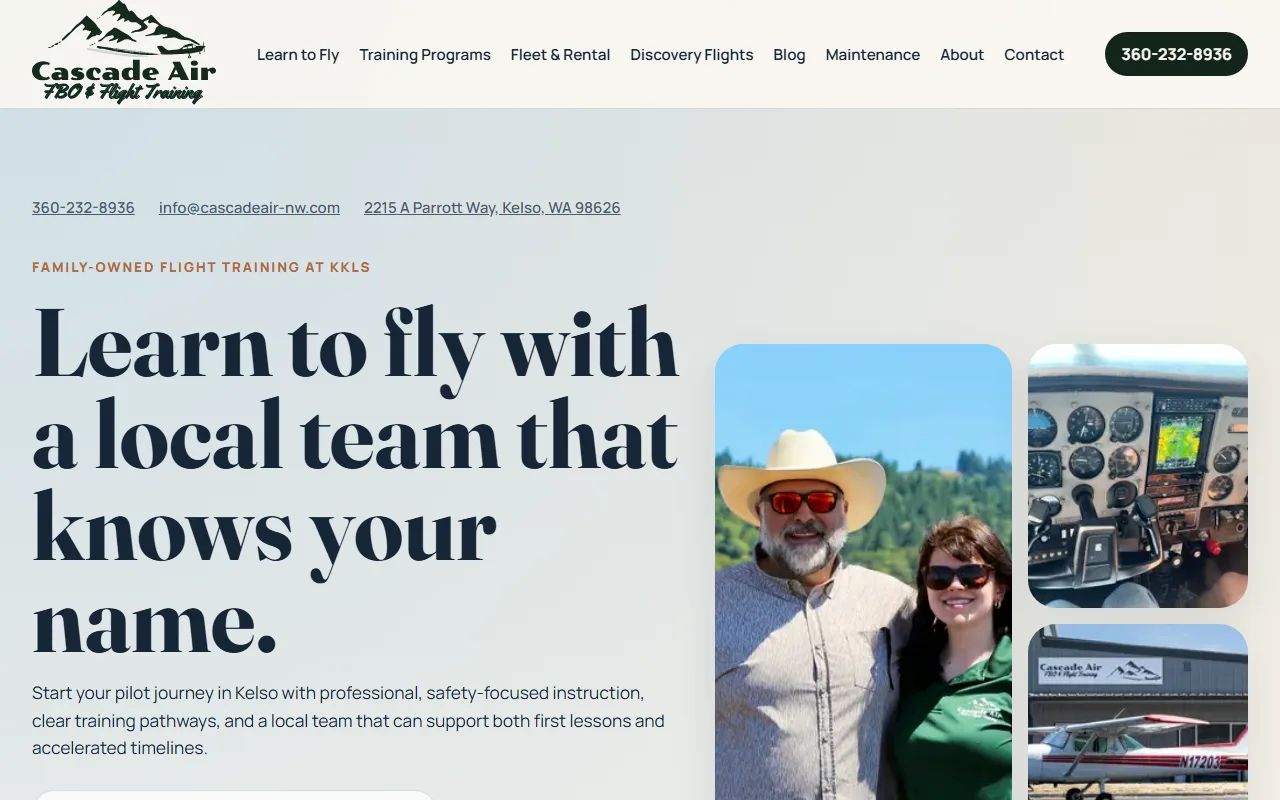
Real clients. Real numbers. Every case study below is an active or former engagement.
Inside the stack
The specialist pages behind the plan.
You do not need to buy these one by one. These pages break down the SEO, website, content, and paid-acquisition work that usually sits underneath the wider flight school growth plan.
Sub-sectors
Sub-sectors we work across.
Helicopter Training
Rotary-wing schools need clearer differentiation around aircraft, pathways, instructor experience, and regional demand than general fixed-wing campaigns.
Pilot Training Pathways
RPL, PPL, CPL, instrument, and instructor pathways should be expressed as distinct conversion pages, not hidden inside one generic training page.
International Student Recruitment
Schools recruiting overseas students need dedicated trust and application pages covering training, support, living logistics, and conversion steps.
Ready when you are
Get a tailored flight school marketing proposal in 48 hours.
Written plan, scope, and pricing by email. No discovery call required.
Frequently Asked Questions
What flight school owners usually ask us.
Yes. We treat fixed-wing and helicopter training as distinct student journeys with separate messaging, content structures, and conversion paths. Our founder is a commercial pilot with a helicopter-category rating and CASA Grade 2 flight instructor credentials who has managed a flight school through the fixed-wing-and-rotary product mix, so rotary marketing draws on operational experience, not adapted templates. Student demographics, career outcomes, cost structures, and decision timelines differ between the two, and marketing must reflect that.
Yes. SEO builds compounding long-term visibility; paid search captures immediate high-intent demand for discovery flights, trial introductory flights, and seasonal enrolment windows; balance depends on school size and market. A Part 61 aero club might run Google Ads targeting "discovery flight [city]" and "learn to fly [city]" while building SEO over six to twelve months; a larger Part 141 academy should invest in both: SEO for programme-specific terms and career pathway queries, paid search for immediate enrolment demand.
Part 61 schools typically attract career changers, hobby pilots, and flexible-schedule students: emphasise scheduling flexibility, individual attention, and the personal flying experience, with local SEO and discovery flight conversion as primary drivers. Part 141 schools attract structured-programme students, often airline-career or international students seeking ICAO-compliant training: emphasise programme structure, completion timelines, airline pathway partnerships, and international student support. They generally have higher budgets and benefit from content targeting career-pathway queries and international recruitment terms.
Depth beyond this page
Authority pages that support this sector
Deeper guides and evidence pages that flight school marketing buyers use to verify the details before they enquire — compliance systems, geo targeting, performance standards, and the results pages behind the claims.
From the Flight School Marketing blog
See all articles →


Ready To Grow?
Want a growth plan for your flight school?
We will map the inbound demand, outbound trial-flight campaigns, and post-flight conversion fixes that matter most for your school.