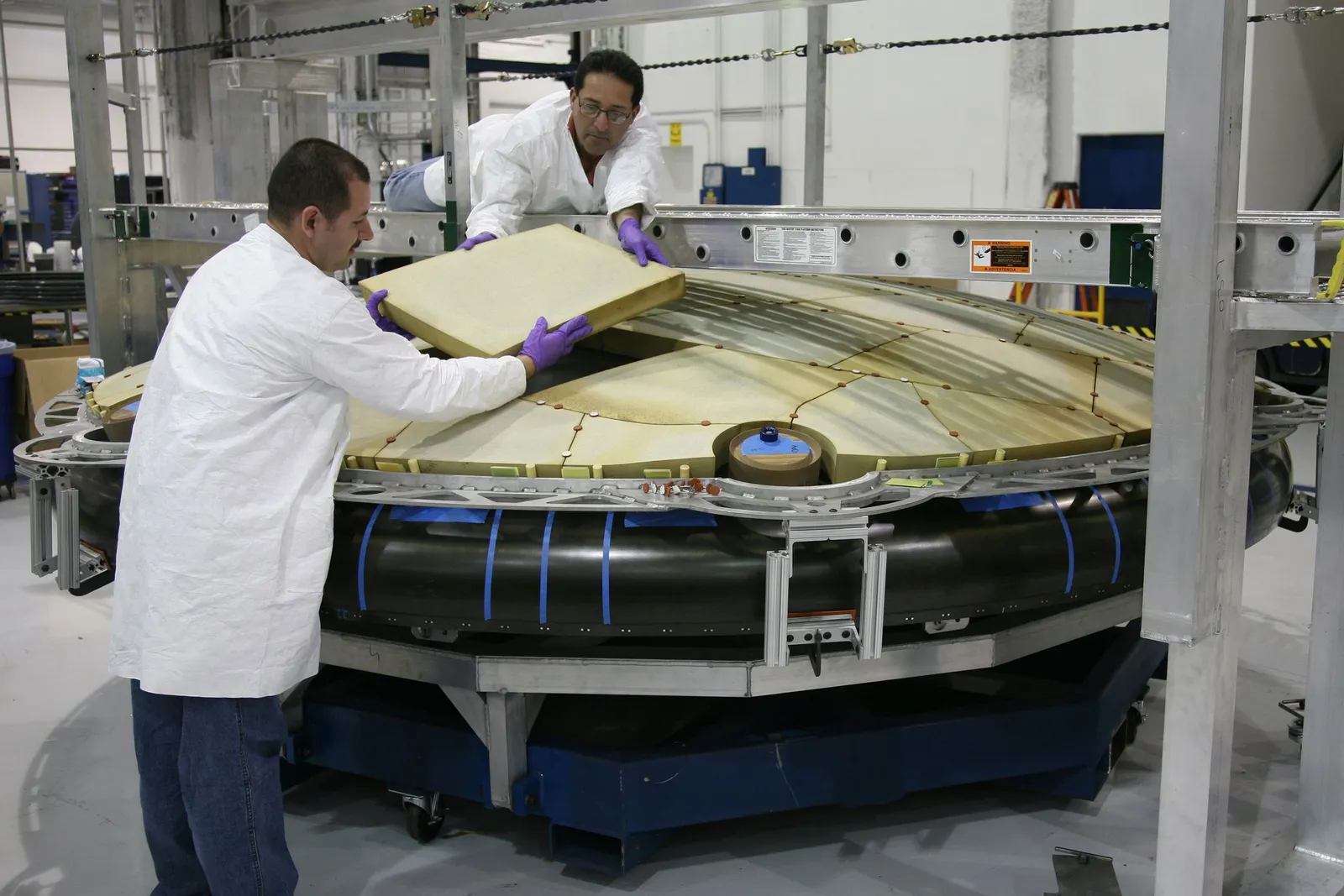

An aerospace supplier can describe what it does in general terms on a public website, and it has to keep controlled technical data off it. The ITAR draws that line itself: its definition of technical data covers drawings, plans and instructions for defense articles, and excludes "basic marketing information on function or purpose or general system descriptions."
This article explains where that line sits in the regulations and how to build a website around it.
Key point
This is general information for marketing and web teams. It is not legal advice. Your export-compliance officer decides what your company can publish, and their decision overrides anything written here.
It covers the two US regimes only, and it quotes only the regulations and the agencies that administer them. Each source is linked where it is used.
What ITAR and EAR are
Two sets of US regulations control what leaves the country, and that includes information as well as hardware.
| ITAR | EAR | |
|---|---|---|
| Full name | International Traffic in Arms Regulations | Export Administration Regulations |
| Where it is | 22 CFR parts 120 to 130 | 15 CFR parts 730 to 774 |
| Who administers it | Directorate of Defense Trade Controls (DDTC), Department of State | Bureau of Industry and Security (BIS), Department of Commerce |
| What it covers | Defense articles and defense services described on the US Munitions List | Items subject to the EAR, which include items in the United States and US-origin items wherever located |
| Word for controlled information | Technical data | Technology |
Both are published in full on the eCFR: the ITAR at 22 CFR parts 120 to 130 and the EAR at 15 CFR parts 730 to 774.
DDTC's own summary says the ITAR governs the manufacture, export and temporary import of defense articles, the furnishing of defense services, and brokering. BIS publishes the EAR with search tools for the Commerce Control List.
The two are kept separate. The EAR says items exclusively controlled by the State Department under the ITAR are not subject to the EAR. Which one covers your part is a classification question, and it comes before any marketing question.
Where the regulations draw the line
Start with the ITAR.
22 CFR 120.33 defines technical data as information required for the design, development, production, manufacture, assembly, operation, repair, testing, maintenance or modification of defense articles. It gives examples: blueprints, drawings, photographs, plans, instructions and documentation.
The same section then says what technical data is not. It does not include general scientific, mathematical or engineering principles commonly taught in schools. It does not include information in the public domain. And it does not include basic marketing information on function or purpose, or general system descriptions of defense articles.
The EAR uses a similar idea with a different word. It defines technology as information necessary for the development, production, use, operation, installation, maintenance, repair, overhaul or refurbishing of an item. Its note lists the forms that information can take, including drawings, photographs, models, engineering specifications, computer-aided design files and manuals.
So both regimes separate two kinds of content. One says what a thing is for. The other tells someone how to make, repair or operate it. Marketing lives in the first kind.
Does putting it on a website make it public?
This is the question that causes the most trouble, and the two regimes answer it differently.
Under the ITAR, public domain has a defined meaning. The section lists the routes by which information counts as public: newsstands and bookstores, unrestricted subscriptions, public libraries, patents, unlimited distribution at an open conference or trade show in the United States, public release after approval by the cognizant US Government department or agency, and fundamental research at accredited US institutions. A company website is not on that list.
Under the EAR, the published section does name the internet. Unclassified technology is published when it has been made available to the public without restrictions on further dissemination, including by posting on sites available to the public.
Do not read either section as permission. The drawing may be your customer's property under a contract. It may be ITAR technical data, where your own posting is not a listed route to the public domain. And both regimes treat the release of controlled information to a foreign person as an export, even inside the United States. The ITAR says so in 22 CFR 120.50 and the EAR in 15 CFR 734.13. A public web page can be read from anywhere.
That is why the decision belongs with compliance. If there is doubt about whether an item is on the US Munitions List at all, the ITAR provides a formal route, the commodity jurisdiction request to DDTC.
Capability statements versus drawings
Here is how that line usually maps onto the content a supplier wants to publish. Treat the last column as a default for your web team, not a ruling.
| Content | What the regulation text says | Default for a public page |
|---|---|---|
| Capability statement: processes, certifications, material families, machine list | Marketing information on function or purpose is outside the ITAR definition of technical data | Draft it, then have compliance review it |
| Drawings, models, CAD files, work instructions, test procedures | Named as technical data and as technology | Keep off the public site |
| Tolerances, performance figures and specifications tied to a defense part | Can be information required for design or production | Compliance decides, item by item |
| Photographs of parts, tooling and assemblies | Photographs appear in both definitions | Compliance reviews each image |
| Program and customer names | Usually governed by your contract and NDA | Written customer approval first |
A capability statement that says you run five-axis milling in titanium under an AS9100 certificate, with the largest part your machines can hold, describes your shop. It does not describe your customer's part.
The trouble starts when capability copy borrows detail from a real job. A named program, a part number, a dimension, a performance figure. Each one moves the page from "what we do" toward "how this item is made."
Write capability pages from your own equipment and approvals. Write case studies by part family and process, with every program detail approved in writing. Our guide to machine shop marketing shows what those pages contain.
Photographs of parts need review too
Marketing teams often assume a photo is safe because it is not a drawing. Both regulations name photographs among the forms controlled information can take.

A wide shot of a machine cutting a block of aluminum is a different thing from a close-up that shows the geometry of a controlled part, a fixture, a traveler sheet or a screen in the background. The photographer will not know the difference. Your compliance officer will.
Build the review into the shoot. Agree a shot list in advance, keep paperwork and monitors out of frame, and send every selected image for approval before it reaches the web team. Keep a record of who approved what.
An RFQ form that routes controlled files off the public site
Buyers need to send you drawings to get a quote. A public upload field that accepts any file from anyone is the wrong way to receive controlled data.
Ask the export-control question first
Put one required question at the top of the form: does this request involve export-controlled technical data? Offer yes, no and not sure.
Hide the upload field unless the answer is no
If the buyer answers yes or not sure, do not offer a file upload. Collect contact details, part family, material and quantity only.
Tell the buyer what happens next
Show a short message: your quote desk will reply with an approved method for sending the technical package.
Hand over to the approved method
The transfer method is your compliance officer's decision. The website's job is to get the right person on your side talking to the right person on theirs.
Keep controlled data out of the marketing systems
Form submissions often copy into email, a CRM and analytics tools. Ask your developer where every field goes, and show that map to compliance.
Put the same instruction beside every email address on the site. A buyer who cannot find the form will attach the drawing to an email instead.
Wording for an export-control statement
A short statement in the footer and on the RFQ page sets expectations. This is a starting draft for your compliance officer to edit, not finished legal text.
[Company] manufactures items that may be subject to US export control laws, including the International Traffic in Arms Regulations (22 CFR parts 120 to 130) and the Export Administration Regulations (15 CFR parts 730 to 774). This website contains general marketing information only. Do not send export-controlled technical data through this website or by email. Contact [role and contact details] to arrange an approved method of transfer.
Be exact about registration as well. 22 CFR 122.1 requires anyone in the United States in the business of manufacturing or exporting defense articles to register with DDTC, and a manufacturer who does not export must still register. The same section says registration does not confer any export rights or privileges.
The regulation describes registration. It does not describe a certification. If you are registered, write "registered with the Directorate of Defense Trade Controls" and leave it there.
Where this fits
Export control shapes every public page a defense supplier publishes, so it belongs at the start of a website project and not at the end. Get compliance sign-off on the page plan before copy is written, and again before launch. Our defense supplier marketing page sets out how we work with Tier 2 and Tier 3 subcontractors, and our aerospace marketing program covers the capability pages and RFQ routes that plan contains. For the wider defense picture, see defense contractor marketing for DoD supply chains. For the identifiers that are safe to state, see our CAGE code lookup guide.
BIS also offers export counselors through its EAR page, a sensible first contact for a company without a compliance officer.
Next step
If you want a second opinion on what your public pages say and how buyers and AI assistants read them, start with the AI Visibility Audit. If you are planning a new site or new capability pages, request a proposal and tell us who signs off export compliance on your side. We reply with a written scope that includes their review at each stage.