

A private jet charter website has to prove four things before anyone asks for a quote: who will operate the flight, under which certificate, in which aircraft, and how fast a real person will reply with a price. Design is how a scheduler finds those four answers in the first minute, usually on a phone.
Many charter sites are handsome and vague. This article covers the proof, in the order a careful buyer looks for it. The build itself is described on our charter website design page.
Operator or Broker: Say Which One You Are
A charter buyer deals either with the company that flies the aircraft or with a company that arranges the flight. Both are legitimate. Leaving the buyer to guess which one you are loses bookings, and in the United States it is also regulated.
The Department of Transportation's air charter broker rules sit in 14 CFR Part 295. Section 295.23 says a broker's solicitation materials and advertisements, web pages included, must clearly and conspicuously state three things:
- that the company is an air charter broker
- that it is not a direct air carrier in operational control of the aircraft
- that the flight will be provided by a properly licensed direct air carrier
Section 295.24 adds that, before a contract is made, the broker must tell the charterer the corporate name of the carrier operating the flight and the capacity in which the broker is acting.
| Operator's site | Broker's site | |
|---|---|---|
| Says up front | "We operate these aircraft on our own certificate" | "We are an air charter broker, not the direct air carrier" |
| Names | The certificate holder, in full | The operating carrier, before the contract |
| Shows | Its own aircraft and crews | How it selects and checks operators |
| Avoids | Presenting aircraft it does not operate as its own | Wording that suggests it flies the aircraft |
This is a summary, not legal advice. Have aviation counsel confirm the wording on your own site. The broker's side has its own page: air charter broker marketing.
Put the Certificate and Safety Ratings in Page Text
An operator's first proof is the certificate. In the US that is an FAA Part 135 certificate. The FAA's Safe Air Charter page links to its current list of certificated air charter operators, and asks passengers to confirm that both the aircraft and the operator are authorized.
So make that check easy. State the certificate holder's legal name and the issuing authority as text, on the homepage or one click from it.
Third-party safety audits come next. The names buyers ask about are ARGUS, WYVERN's Wingman certification and IS-BAO, the business aircraft operating standard run by IBAC. Rating names change over time, so copy the wording from the auditor and not from an old brochure.
Key point
A badge image is not proof on its own. Write the rating name, the auditor and the audit date as text beside it. People can read a logo. Search engines and AI assistants read the words.
Brokers need extra care here. Section 295.50 of the same rules lists, among unfair or deceptive practices, misrepresenting an affiliation with an organization that audits brokers or carriers, or that a broker or carrier meets an auditor's standards.
Aircraft Pages Built From the Fleet You Operate
Give each aircraft type you operate its own page: seats, realistic range from your base, baggage, cabin layout, year and last refurbishment. If an aircraft is managed and available by arrangement, say so.
A broker's site should not present a "fleet" unless it explains that these are aircraft types it can source from operators.
We covered page structure in detail in charter operator website must-haves, so this is the short version. The point for design is that the aircraft page is where the scheduler decides, and it needs a quote button for that aircraft on it.
Photograph the Actual Fleet
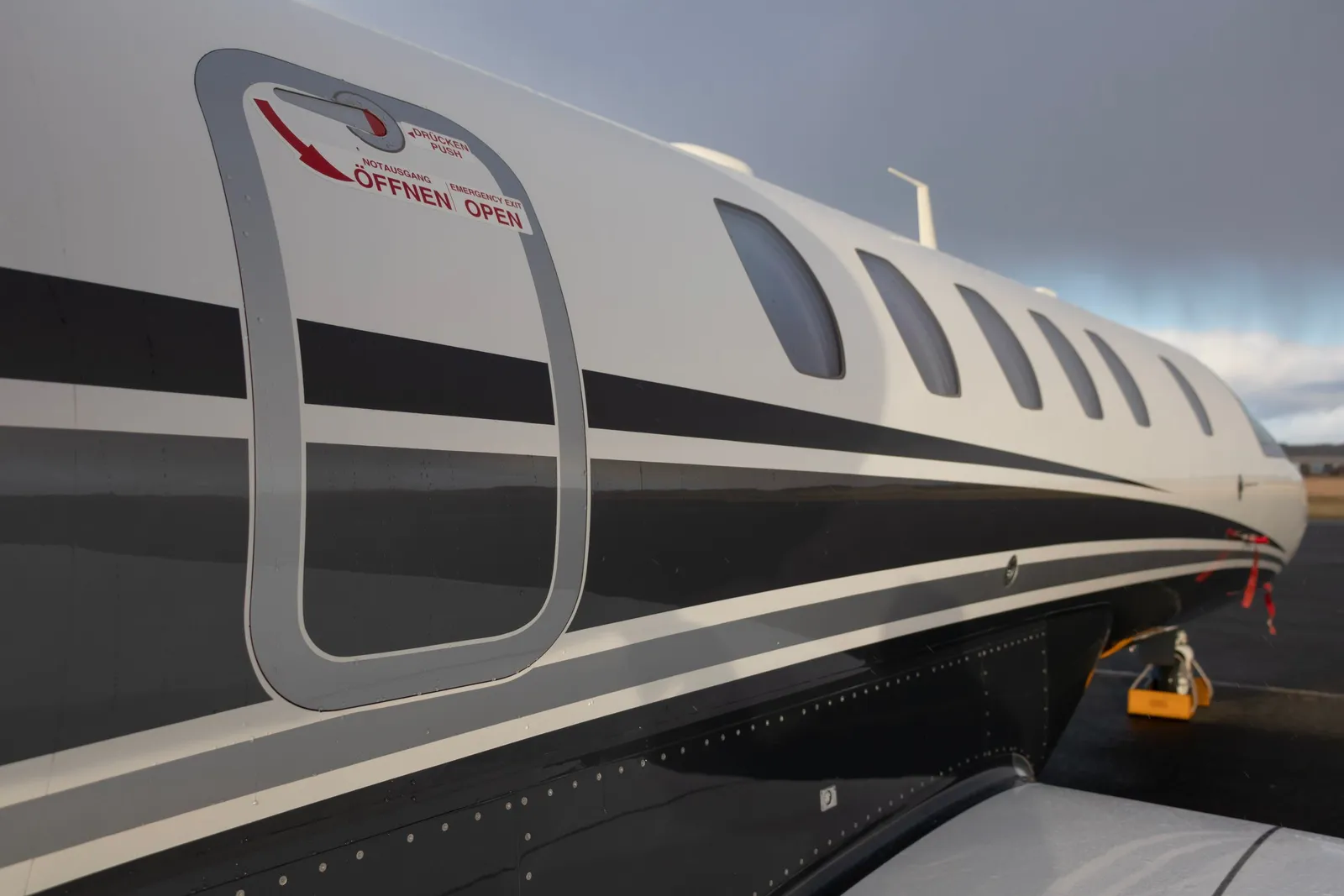
Stock cabin interiors are the fastest way for an operator to look like a broker. Shoot your own aircraft: the exterior on your ramp, the airstair down, each seat group, the galley, the baggage hold with real bags in it, and the crew who fly it.
Caption each photo with the aircraft type and, where you are comfortable, the registration. A scheduler can then match the photo to the aircraft page and to the quote.
Route Pages for Trips You Fly
Build route and airport pages from your trip history, not from a list of popular cities. Each one should name the airports you use, the usual block time, the aircraft that suit the trip and what moves the price.
A page for a route you cannot fly well brings quote requests you cannot win.
The Quote Path
A quote request is a short procedure, and the site should run it the same way every time.
Ask for the trip, not a life story
Date, departure and arrival airports, passenger count and how flexible the timing is. A phone number and an email. Nothing else on the first screen.
Acknowledge at once
An on-screen message and an email that say who will reply and roughly when. If you publish a response time, keep to it.
Route it to someone who can quote
The request goes to the scheduling desk by email and text, with the trip details in the message. It does not go to a shared inbox checked twice a day.
Reply with a price and a name
The quote names the aircraft, the operating carrier and the person sending it. A broker's quote names the operator.
Response speed is a subject of its own. See charter quote response time and conversion.
Speed on a Phone
Charter requests are often sent between meetings, on whatever signal is available. Google's web.dev guidance on Largest Contentful Paint counts a page as loading well when its main content appears within 2.5 seconds.
Hero video and uncompressed cabin galleries are the usual reasons a charter site misses that mark. Serve photos at the size the screen needs, load video only after the page is usable, and keep the phone number as a tap-to-call link in the header.
What AI Assistants Take From the Site
Schedulers now ask ChatGPT, Gemini and Google's AI Mode which companies fly a route. On 17 November 2026 we put 60 buyer-style questions to those three assistants and published the results. US charter questions had the least agreement: 79% of the businesses named for them came from a single assistant.
That was one evening's snapshot, and answers change between runs. The practical point holds either way. An assistant can only repeat what a site states in text: who operates, on which certificate, with which aircraft, from which airports. That is the same list a scheduler needs.
Next Step
The only charter result we publish is this one: a North American charter operator's cost per qualified lead went from $180 to $4.20. It is on our work page.
If your site looks right and still leaves a buyer guessing who flies the aircraft, see how we approach charter website design, or request a proposal with your fleet, your base and your certificate or broker status. To see how assistants describe your operation today, start with the AI Visibility Audit.