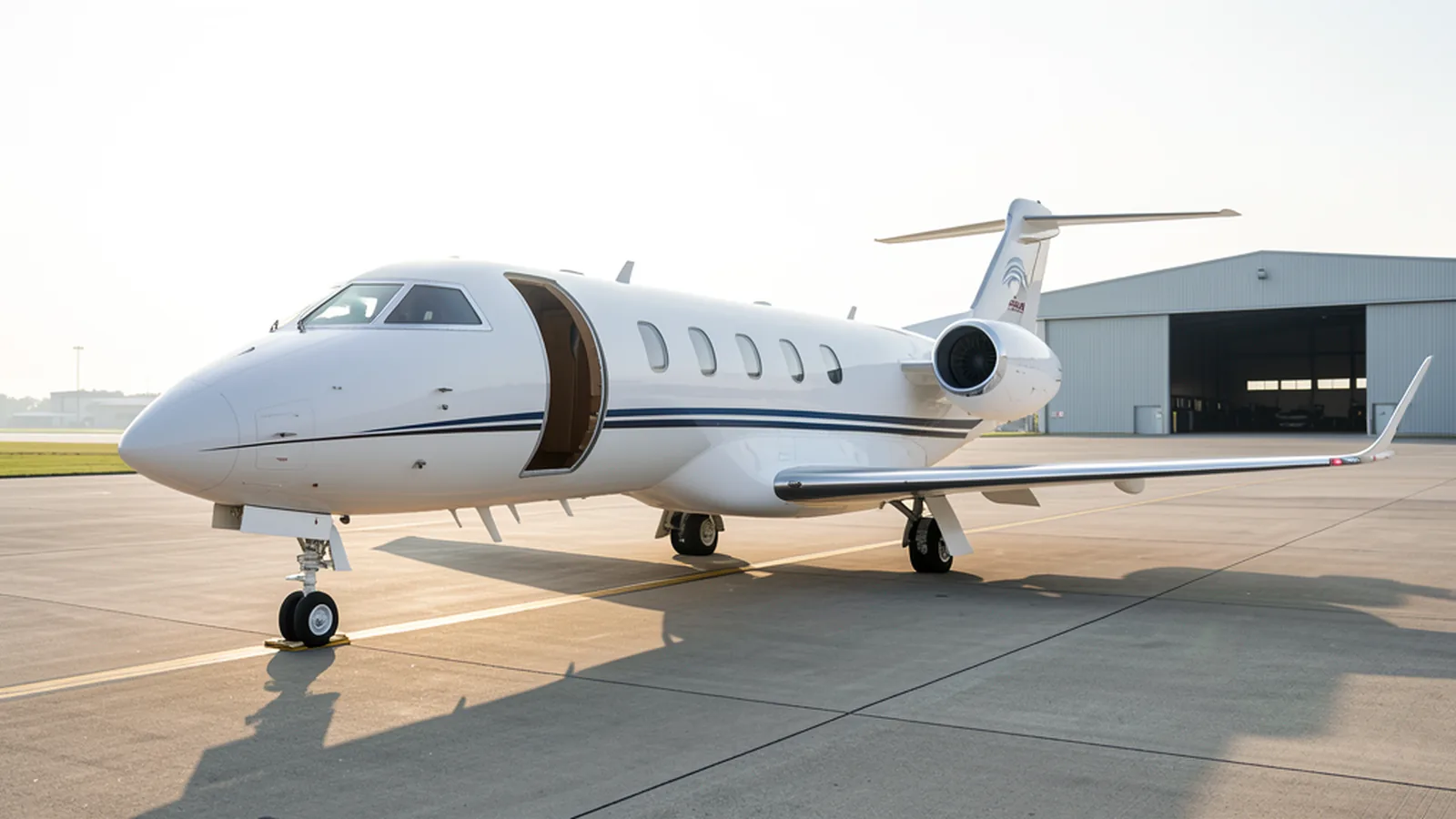
Private jet charter marketing that wins direct quote requests, not broker leads.
Owned-fleet operators offer what brokers cannot: direct accountability, known aircraft, known crew, and verifiable operational integrity.
Tailored plan by email in 48 hours. No sales call required.
Part of
Charter Marketing
This is one of our specialist pages inside the wider charter marketing offering. If you need the full picture first, start there.
See the full charter marketing page →Quick answer
How do you get more private jet charter enquiries?
Match each high-intent search to a real route, aircraft category, mission, and service area; make the operator identity, certificate, fleet, base, and response expectation clear before the form; ask only for the trip details needed to qualify and route the request; reply through an owned workflow; and connect the original page and campaign to qualified quote and booked revenue. A broad national charter page cannot answer a buyer who already knows the city pair, passenger count, date, and aircraft requirement.
Fit check
Is charter marketing with OTG the right fit for your operation?
Right fit
- Operators where charter marketing sits inside the priority commercial path — discovery flights, quote requests, owner acquisition, or RFQ-qualifying enquiries depending on sector.
- Teams who want a team that understands charter marketing regulatory and operational language without a translator — Part 61, Part 135, Part 141, Part 145 depending on your category.
- Operators who want mission-specific landing pages, transparent AOC documentation, and structured quote-request flows that capture direct bookings.
- Teams who know a serious charter client converts on confidence in the operator's safety record, aircraft reliability, and crew credentials — not price alone.
Not the right fit if…
- Operators who prefer filling the schedule through broker aggregators at reduced margin rather than building a direct-booking path.
- Teams looking for a 30-day turnaround on competitive charter search terms — not realistic for any specialist.
Search journey
How aviation operators actually land on a charter marketing page.
Your customer doesn't search the way generalist agencies assume. They start with a regulatory or operational query specific to charter marketing, qualify you against one or two named competitors, then look for proof you've worked with an operator that looks like them — in that order.
Start broad
Charter Marketing
Most operators begin on the wider sector hub first, then narrow into the exact page type that matches the search they trust most.
Common searches
What usually gets compared next
These are the recurring problems, use cases, and intent patterns we see before someone commits to a page like this.
Adjacent pages
Pages they compare before enquiring
A serious reader usually moves laterally across the closest adjacent pages before deciding which route to pursue.
Conversion step
What moves them to contact
Once the fit is clear, they usually check scope or ask for a proposal tied to the exact page they landed on.
The problem
Why charter marketing pages stop generating enquiries.
Owned operators lose enquiries to broker aggregators because their websites do not communicate the trust differential. A corporate travel manager who cannot quickly verify aircraft, safety credentials, and operational accountability will default to a broker platform — even if your direct operation is safer, faster, and better value.
Most private jet websites lead with aesthetics rather than enquiries. Cinematic homepages and lifestyle photography say nothing about ARGUS Platinum ratings, SMS programmes, or crew standards — the factors that close corporate accounts.
Corporate customers need to verify aircraft type and availability, base location, service standards, and regulatory compliance before they will send a serious enquiry. Sites that obscure these details in favour of brand messaging lose that customer at the research stage.
High-value leads are often lost between quote request, internal response, and follow-up because the enquiry system is not built for speed. Private jet customers expect a qualified response within minutes, not hours — a slow or generic reply loses the account to a competitor who responded faster with a named crew and aircraft.
What we build
What we actually build for charter marketing operators.
Position fleet ownership and safety credentials as the lead trust signal — ARGUS, Wyvern, IS-BAO ratings, Part 135 certificate, and operational transparency front and centre, not buried in an About page.
Build dedicated landing pages for aircraft type and mission category — light jet corporate shuttle, large cabin transcon, medevac, leisure — so each customer lands on content that matches their specific intent and budget.
Target the customer who wants a direct operator relationship, not a broker intermediary: corporate travel departments, executive assistants, mine site logistics coordinators, and high-net-worth repeat flyers who value consistency over lowest-price aggregation.
Improve response architecture with better forms, clearer qualification, and CRM tracking so each high-value lead is captured, routed, and responded to faster than a broker can aggregate a quote.
The shift we look for in owned-fleet operators: a growing share of enquiries arriving direct rather than via a broker intermediary by the 9-month mark after the SEO and website rebuild lands — the number that tells you the trust differential is reaching corporate travel managers at research stage.
Next step
Want a plan without a sales call?
Tell us about your current site, who you want to reach, and what you actually sell. We'll come back with a tailored plan within 48 hours — no call required.
Request Proposal →Video explainer
See how the system works.
A buyer searches a route, compares operators — and a broker matches the quote while your aircraft flies the trip at your cost. The route-pages, credentials, and economics fix for Part 135 operators.
How it works
From brief to qualified charter marketing enquiries.
No discovery call to start. You tell us the operation; we map the search landscape, build the pages and enquiry path, instrument the conversions, and report on enquiries — not impressions.
Map the opportunity
We audit your current site and search landscape against the operators already winning your terms, then agree the pages and quick wins that matter first.
Build the pages + funnel
Sector-specific landing pages, the enquiry path, and the proof a serious operator checks before they make contact — built to convert, not only to rank.
Instrument the enquiries
Search Console and GA4 wired to the actions that matter — proposal and audit requests — so the work is measured on qualified enquiries, by cluster.
Report on what converts
Monthly reporting that explains lift per page and per enquiry path, so spend follows what is actually producing customers.
Proof
See the work we've shipped for operators like you.
Services
Services we usually pair with this.
Keep reading
Where aviation operators usually go next.
Frequently Asked Questions
What operators usually need answered before they enquire.
It includes demand capture and enquiry operations: route and aircraft SEO pages, paid search for qualified mission intent, clear operator and safety information, concise quote forms, call and form tracking, CRM routing, response-time controls, follow-up, and closed-loop reporting from enquiry to booked flight. Charter marketing creates the search presence; lead generation turns that presence into a qualified, traceable request.
Broker platforms compete on price aggregation and convenience. Direct operator marketing competes on trust, consistency, and verified quality. The messaging, page architecture, and enquiry path are fundamentally different. A direct operator needs to communicate aircraft ownership, crew standards, safety ratings, and operational reliability — not just price and availability.
Operators with two to four aircraft can compete effectively in SEO by going narrow and deep: dominating their primary base, their key routes, and their specific aircraft types rather than attempting to rank nationally for broad charter terms. A focused operator with strong local and route-specific rankings often generates better qualified leads than a larger competitor with a thin national presence.
Route and aircraft-specific pages targeting clear search intent often show ranking improvement within three to six months. More competitive geographic terms take six to twelve months depending on how strong your site is with Google today. Most operators see meaningful organic enquiry growth in the six to nine month range when the technical foundation, content depth, and links between pages are built correctly from the start.
Yes. They require different landing pages, messaging, and qualification logic — we separate those journeys instead of forcing them through one generic quote form. Corporate accounts want flight-department-grade verification (ARGUS, SMS, pilot experience, aircraft certification). Leisure and high-net-worth customers respond to experience, consistency, and discretion. Running both through the same journey dilutes both enquiry paths.
Direct enquiry growth needs three things working together: strong rankings on route-specific and aircraft-specific terms (Sydney–Karratha, Citation X transcon, Light Jet ATL–MIA), trust signals that surface ARGUS / Wyvern / IS-BAO ratings before the visitor reaches a quote form, and response architecture that captures the enquiry in under 30 seconds with the right qualification fields. Ship all three and direct enquiries grow as a share of quote volume month over month, while the broker share shrinks.
Lead generation is the enquiry layer: the forms, qualification logic, response time, and follow-up sequence that turn a visitor into a routed enquiry. Charter marketing is the search layer: the SEO, content, and paid search that bring the visitor to the site. Most operators have one without the other, either traffic with poor capture or strong forms with no traffic. Both layers need to ship together to move direct booking volume.
Owner-operators win on what aggregators cannot replicate: verified aircraft, named crew, direct accountability for safety standards, and pricing that does not carry a broker margin. The marketing work makes those differences visible at the research stage: aircraft-specific landing pages, route pages that name the actual tail offered, and trust pages that surface certifications before pricing. Customers who want to know exactly which aircraft and crew will operate their flight self-select away from aggregators when that information is on the site.
Direct enquiries change your schedule's shape, not just volume. A broker-fed book leaves gaps the aircraft and crew sit through unpaid. Route-specific and aircraft-specific pages bring enquiries direct, so you pick trips pairing with your repositioning legs, crew duty windows under FAR 135.267, and the city pairs you fly. The same airframe hours and crew produce more revenue trips. Watch revenue hours per available aircraft day alongside enquiry count: direct demand you can shape moves it; broker overflow does not.
Ready To Grow?
Want a page like this — but for your charter marketing?
We'll audit your current charter marketing pages against the operators ranking above you, identify the keyword + proof gaps, and send back a 48-hour proposal with scope, priorities, and price. No discovery call required.