Drone Lead Generation: How to Build a B2B Pipeline
How commercial drone service companies generate qualified leads: define a niche, sell the outcome, use LinkedIn, SEO and Google Ads, and track a real pipeline.
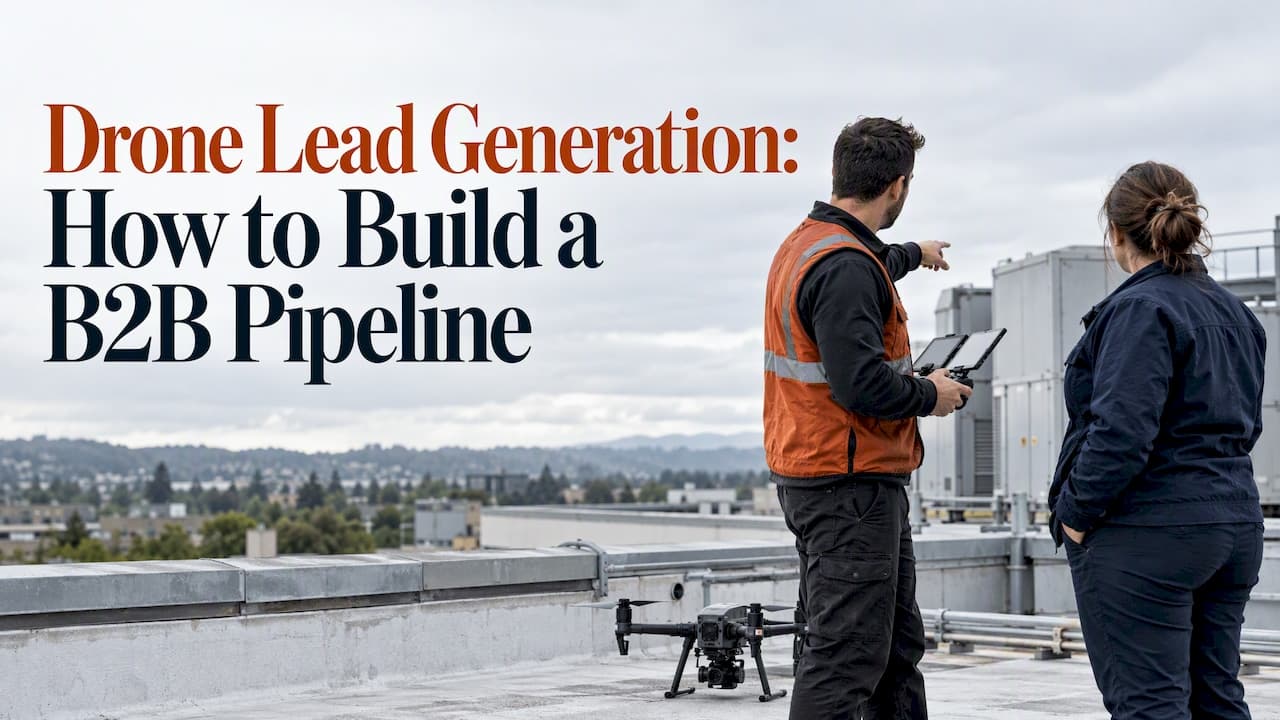
Drone lead generation works when you stop selling aircraft and start selling a finished result to a buyer with a budget. For a commercial operator, that means a narrow offer, a website and documents that a procurement team can use, and two or three channels you can measure: search, LinkedIn and paid ads. This guide is for inspection, survey, mapping and asset-data companies selling to businesses, not for hobbyists or one-off photo jobs.
TL;DR
- Enterprise buyers compare a drone against rope access, scaffolding or an in-house crew. They are not comparing you to other drone companies, so lead with the operational outcome.
- Replace “drone services for everyone” with one precise deliverable for one type of buyer.
- Build proof assets (case data, sample deliverables, compliance documents) that your contact can forward to a finance or operations lead.
- Start with search, LinkedIn and targeted Google Ads, and track enquiries through to signed work, not just clicks.
- Part 107 compliance is a trust signal. Show it plainly, and never imply you can operate outside the rules.
Table of Contents
- Who buys drone services, and what they are really shopping for
- Define a niche a buyer can recognize in five seconds
- Build the assets that move a deal through procurement
- The channels that produce qualified drone leads
- A simple pipeline you can track
- What this costs
- Perspective: what we see in drone marketing
- Work with a team that understands the aviation side
- FAQ
- Sources
Who buys drone services, and what they are really shopping for
A roofing estimator, a utility asset manager and a solar EPC project lead all buy drone work, but none of them wakes up wanting a drone. They want fewer site visits, a shorter inspection window, safer access or a cleaner dataset for a report.
Our own analysis of drone inspection marketing makes the point directly: B2B buyers in this sector are weighing the value of using a drone against traditional methods such as rope access or internal teams. That changes what your marketing has to do. The question your website answers is “why is this the better way to do the job?” Camera resolution and flight time come second.
The same piece warns that marketing built around specifications tends to fail because it frames the service as a commodity. If a buyer sees a list of aircraft and sensors, the only remaining comparison is price.
The two people in every deal
Most enterprise purchases involve at least two people. The first is your primary contact, such as an asset manager or project engineer, who understands the problem. The second is a secondary stakeholder, such as a CFO or operations director, who signs off on the spend.
Successful providers build material the first person can hand to the second. It needs specific, checkable numbers. A line like “reduced the inspection window from three weeks to 72 hours” survives a procurement meeting. “High-quality aerial imagery” does not.

Define a niche a buyer can recognize in five seconds
The most common mistake in drone marketing is breadth. A homepage that lists real estate, weddings, roofing, mapping, thermal and events tells a serious buyer that you are a generalist.
Drone Authority’s guide to getting clients recommends naming the deliverable itself, for example “20 labeled roof images for estimators” rather than “aerial inspections”. The buyer instantly understands what arrives in their inbox and to what standard. Association For Drones gives similar advice: focus on specific industries where you can add measurable value instead of trying to be everything to everyone.
A practical way to define the niche is to fill in one sentence:
We deliver [specific output] to [specific buyer role] in [industry] within [turnaround], replacing [the current method].
Examples of what that can look like:
| Weak positioning | Sharper positioning |
|---|---|
| Aerial inspections | Roof condition imagery, labeled and delivered for insurance estimators |
| Drone mapping | Monthly progress orthomosaics for commercial construction managers |
| Thermal drone services | Thermal anomaly reports for solar O&M teams, panel-level and exportable |
| Drone surveys | Corridor survey data for utility vegetation management programs |
You can still do other work. The niche is the front door, not a limit on what you will accept once a client trusts you.
Build the assets that move a deal through procurement
Before you spend on traffic, check what a visitor finds when they arrive. The pages that generate enquiries for B2B drone companies usually share the same few elements.
- A service page per deliverable and industry. One page for “drone roof inspection for insurers” will outperform a single “Services” page, both for search and for conversion.
- Sample deliverables. A redacted report, a sample orthomosaic, a data dictionary. Buyers want to see the standard before they call.
- Case results with numbers. Time saved, site visits avoided, cost compared with the old method. If a client will not be named, describe the type of client and the measurable result.
- Compliance and safety documents. Pilot certification, insurance, operating procedures and how you handle incident reporting.
- A short, specific enquiry path. Ask for the site type, the deliverable, the location and the timeline. Do not ask visitors to “tell us about your project” in an empty box.
If your site is the weak link, our drone company website design page explains how we structure sector pages for enterprise buyers.
Make compliance visible
Compliance is not a footnote in B2B drone work. Under the FAA’s rules, anyone flying for commercial or other non-recreational purposes must hold a remote pilot certificate and register their drones. The agency’s Part 107 summary covers operations with drones weighing less than 55 pounds.
For your marketing, that means a plain statement of who holds a current certificate, what your registration and insurance position is, and how you operate. A safety or risk manager reading your site is looking for exactly that. If your work involves waivers or operations beyond the standard Part 107 envelope, say which approvals you hold and let the buyer ask for documents. Check the FAA pages directly for the current rules before you publish any claim, because requirements change.
Our Part 107 commercial drone marketing page covers how to turn that compliance into positioning.
The channels that produce qualified drone leads
No single channel does everything. For most commercial operators, three carry the load, with email and referrals supporting them.
Search: capture people who already have the problem
A buyer who types a specific job into Google, such as a roof inspection, a powerline survey or a stockpile volume measurement in their city, has a budget and a deadline. Search is where a drone company’s best leads often start.
Search queries from serious buyers are specific and local. Our guide on how to market your drone business notes that clients search for phrases like “drone roof inspection” plus a city, not for “cool drone shots”. Your site should have a page for each service and each major market you serve, with the deliverable, the process and proof on it.
Practical steps:
- Write one page per service-and-industry pair, not one page per keyword variant.
- Add your service area to titles and headings only where you actually operate.
- Complete your Google Business Profile with the right categories, service areas and photos of real deliverables.
- Publish case material that uses the words buyers use, such as “inspection window”, “site visit” and “asset condition”.
Our SEO for drone companies page goes deeper on how this works for enterprise contracts.
LinkedIn: where the buyers and referrers already are
B2B drone work is relationship-heavy, and LinkedIn is where asset managers, engineers and consultants spend time. A 2026 compilation of industry statistics reports that 71% of commercial drone service providers use LinkedIn for B2B marketing, and that 58% of leads come from industry-specific groups. Treat those as directional figures from a statistics roundup, not as a benchmark you are guaranteed to match.
What works in practice:
- Post project breakdowns: the problem, the method, the data, the time saved. Skip generic drone footage.
- Make sure the pilots and project leads have profiles that state the niche, not just “drone pilot”.
- Join and contribute to groups where your buyers talk, such as energy, construction, insurance or infrastructure forums.
- Connect with a defined account list and follow up with a useful sample, not a pitch.
We lay out the approach in our LinkedIn strategy for enterprise drone service companies.
Google Ads: fast, but only with tight targeting
Paid search can fill a pipeline in weeks, which organic search cannot. It can also burn budget quickly on hobbyists and people looking for drone jobs or drone shows. That is why the keyword list, negative keywords and landing pages matter more than the bid.
A few rules we apply:
- Target the job, not the aircraft. “Roof inspection drone service” brings buyers. “Buy drone” brings shoppers.
- Exclude terms such as “jobs”, “course”, “license”, “cheap” and “hobby” from the start.
- Send each ad group to a page that matches the exact deliverable.
- Count a lead only when it matches your criteria, and review that weekly.
More detail is in our guide to Google Ads for drone companies.
Email and outreach
Outbound email works when it is specific and gives the recipient something to look at. The same statistics roundup says 52% of B2B marketers use drone-generated content in email campaigns, with a reported 22% higher open rate than standard outreach. Again, treat it as a signal, not a promise. A short email with one before-and-after image from a comparable site, sent to a named role at a company that owns similar assets, will outperform a brochure.
A simple pipeline you can track
Leads are not the goal. Signed work is. A basic pipeline for a small commercial drone company has five stages, and you should be able to say how many opportunities sit in each one.
| Stage | What it means | What to measure |
|---|---|---|
| Enquiry | Someone contacts you or requests a sample | Source, service, location |
| Qualified | The job matches your niche, budget and location | Percentage of enquiries that qualify |
| Scoped | You have discussed the site, deliverable and timeline | Time from enquiry to scope |
| Proposal | A written quote has gone out | Proposal value, response time |
| Won | The contract is signed | Win rate by source |
Two habits keep this honest. First, record the source of every enquiry, including the phone calls, which are often the most valuable and the most poorly tracked. Second, review win rate by source every month. A channel that produces many enquiries but few won jobs is costing you more than it appears.
A CRM with automated follow-up helps here, because enterprise buyers often take weeks to reply and a prompt, relevant follow-up can be the difference between a lost lead and a pilot project.
What this costs
Budget depends on how much of the work you do in-house. For reference, these are our published prices at the time of writing:
- Aviation SEO from $1,500 per month.
- PPC and advertising from $3,000 per month, with ad spend paid separately to the platform.
- Site builds from $3,500 one-off (Starter Site), $5,500 one-off (Growth Site) and from $9,000 one-off (Enterprise Site).
- CRM setup and lead nurture automation at $2,000 one-off.
Full details, including monthly plans, are on our pricing page. A reasonable approach for a smaller operator is to fix the website and positioning first, then add search, and add paid ads once you know which services convert.
Perspective: what we see in drone marketing
We are commercial pilots and aviation operators who now run marketing for aviation businesses, and drone companies make the same mistake we see everywhere in this industry: they describe the equipment because that is what they love. Buyers do not share that love. They have a bottleneck, a regulator, a budget committee and a deadline.
When we rebuild a drone company’s marketing, we start by asking what the buyer would have done without you. If the answer is “sent two people up a tower”, then the story is about safety, speed and data quality. The aircraft barely appears. We also push clients to show their compliance posture openly, because for an enterprise safety team it is a reason to say yes.
The companies that grow fastest tend to have a narrow offer, a handful of strong case studies with real numbers, and the discipline to measure what each channel returns. None of that needs a big budget. It needs focus.
— Joe
Work with a team that understands the aviation side
If you want help turning a drone operation into a steady source of enterprise enquiries, our enterprise drone lead generation service covers positioning, search, paid ads, website and reporting for commercial UAS companies. You can also see our full range on the Off The Ground Marketing home page.
FAQ
How do I get my first B2B drone clients?
Start with a narrow offer and a short list of target companies that own the kind of assets you inspect or survey. Offer a small paid pilot or a sample deliverable, then turn the result into a case study. Drone Authority’s plan takes the same approach: sell a finished result, not flight time or certificates.
Is drone lead generation different from general drone marketing?
Yes. Drone marketing covers awareness, branding and content. Lead generation is the part that produces named enquiries you can follow up on and track to a contract. The two work together, but a lead generation plan is measured by qualified enquiries and won work.
Do I need a Part 107 certificate to market commercial drone services?
If you or your pilots fly for commercial purposes in the United States, the FAA says the remote pilot must be certificated and the drones registered, as set out on its Getting Started page. Check with the FAA, or an aviation attorney if your operation is complex, before advertising services that depend on waivers or special approvals.
Which channel should a small drone company start with?
Begin with a clear service page and a completed Google Business Profile, then add LinkedIn activity aimed at a defined list of buyers. Add Google Ads once your pages convert, so you are not paying to send traffic to a weak page.
What should I put in front of a buyer who needs to justify the spend?
Give them specific numbers and a document they can forward: time saved, site visits avoided, a sample deliverable and your compliance details. Our analysis of drone inspection marketing explains why verifiable data matters when a second stakeholder reviews the purchase.
Sources
- Marketing In The Drone Industry: 2026 Research Stats (ZipDo)
- How to Get Drone Clients (Drone Authority)
- How to Market Your Drone Services Effectively (Association For Drones)
- Getting Started (Federal Aviation Administration)
- Small Unmanned Aircraft Systems Regulations, Part 107 (Federal Aviation Administration)
Recommended
Aviation Marketing Notes
One operator-shaped read per week. No agency newsletter padding.
Joey shares the patterns we see across flight school, charter, MRO, and FBO clients. Practical. Aviation-specific. Unsubscribe whenever.