Aviation Social Media Strategy for Operators, MROs and Schools
A practical aviation social media strategy for charter operators, MROs and flight schools: platforms, content mix, LinkedIn ads, response habits and metrics.
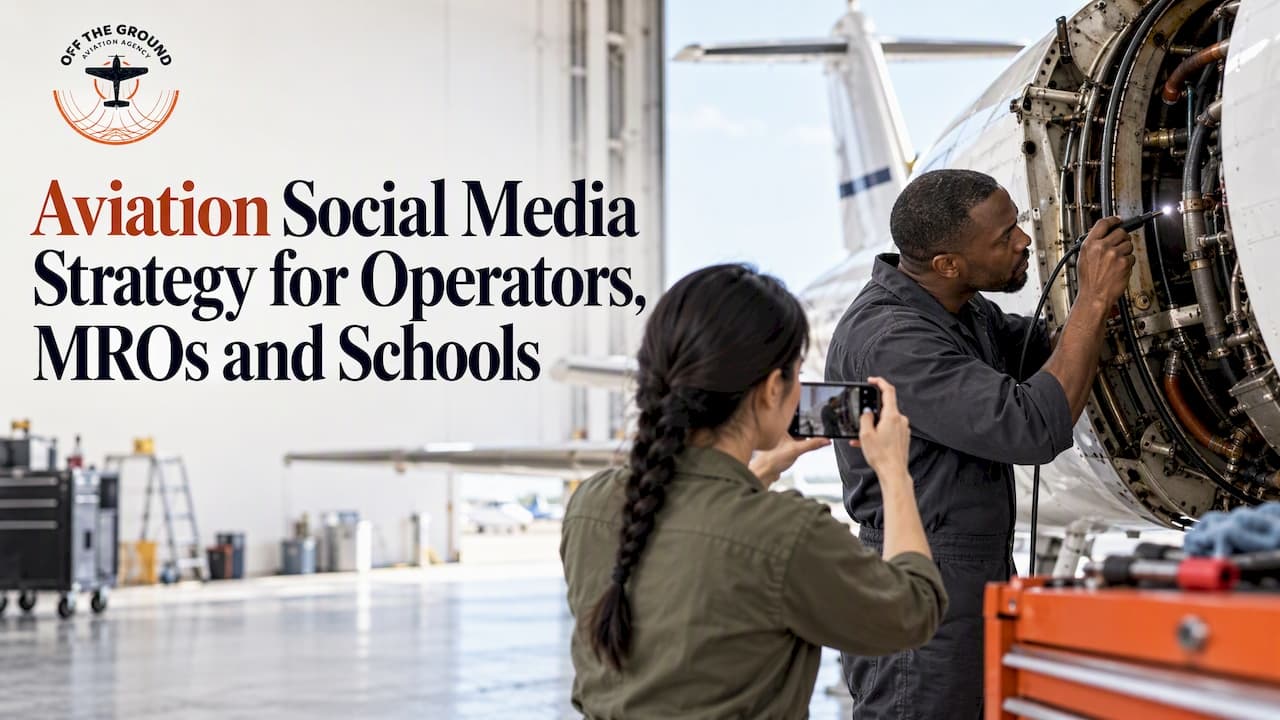
An aviation social media strategy works when it does three things: it picks the one or two platforms where your buyers already are, it builds trust with content that reflects how aviation people think, and it ties every post to an inquiry, quote request or booked call. Likes are not the goal. This guide is for charter operators, MROs, flight schools, aircraft managers, FBOs and drone service companies that sell to other businesses or to serious prospects, and it shows how to build that strategy step by step.
TL;DR
- Pick platforms by buyer, not by habit: LinkedIn for MRO, fleet and management sales, Facebook and Instagram for demand creation among charter and training prospects.
- Social media in aviation mostly builds familiarity long before a buyer is ready. Plan for a long runway and measure inquiries, not reach.
- Answer comments and questions. Research on airline accounts found most public questions go unanswered, so a fast reply is an easy edge.
- Keep ad audiences broad enough to work. Combine aviation interests with business-travel or life-stage signals instead of stacking filters.
- Run one genuine voice. Aviation is a small world, and buyers check how you behave online.
Table of Contents
- Start with the buyer, not the platform
- Choose platforms by sales motion
- Think demand creation, not just lead capture
- Build a content mix that fits aviation
- LinkedIn for MRO, management and charter sales
- Facebook and Instagram ads: targeting without shrinking your audience
- Be present: respond to every question
- One genuine voice
- Perspective: what we see in aviation accounts
- A simple 90-day plan
- Metrics that matter
- Getting help
- FAQ
- Sources
Start with the buyer, not the platform
Most weak aviation social strategies begin with “we should be on Instagram.” Strong ones begin with a sentence like this: “We want more owner inquiries for our management program” or “We want procurement and maintenance leads to know our turnaround times before they need a shop.”
Write down, for each service line:
- Who decides. A director of maintenance, a chief pilot, an aircraft owner, a parent paying for training, a flight department manager.
- What they worry about. Turnaround time, regulatory compliance, safety record, hidden fees, schedule reliability.
- Where they spend attention. Professional feeds, local community groups, video, or search.
- What action you want. A quote request, a discovery flight booking, a call, a download.
This four-line exercise decides your platform mix, your content and your budget. Without it, you will post pretty airplane photos that nobody buys from.
Choose platforms by sales motion
| Business | Primary platform | Secondary | Main job of social |
|---|---|---|---|
| MRO, avionics shop, parts supplier | YouTube | Show capability, certifications, turnaround, people | |
| Charter operator | Instagram, Facebook | Create demand, reframe private travel as time saved | |
| Charter broker | Credibility with corporate travel buyers | ||
| Aircraft management | Reach owners and prospective owners | ||
| Flight school | Facebook, Instagram, YouTube | Local groups | Show the training experience, reduce fear of the first step |
| Drone services | YouTube | Case studies for commercial and public-sector buyers |
The NBAA’s career guide notes that scrolling jobs on LinkedIn is a good way to take the pulse of business aviation, and that social media is involved in some way for almost everyone who finds a job today. The same professional network that hires people is where your B2B buyers research companies, so treat your LinkedIn page as part of your sales material.
For consumer-facing aviation, the picture differs. One practitioner write-up describes Facebook as a discovery platform: people scroll to consume content, not to search for a charter operator or commit to a costly pilot program. That changes what you post and what you ask for, which we cover below.
Think demand creation, not just lead capture
Search and Google Ads catch people who already want to buy. Social media reaches the much larger group who will buy eventually. The same practitioner source argues that aviation marketing succeeds through demand stimulation, such as reframing private travel as a time-saver rather than a luxury, so that your brand is the one that comes to mind when the need appears.
In practice, this means your feed should regularly answer questions your buyer hasn’t yet asked:
- A charter operator shows a real itinerary: three meetings in three cities in one day, and what that would have cost in hours on commercial flights.
- An MRO shows an inspection from induction to return to service, with the people who did the work.
- A flight school shows a student’s first solo and the steps it took to get there.
- An aircraft manager explains where owners’ costs actually go.
None of these posts say “call now.” They make the buyer familiar with you and confident in you. Pair them with a smaller number of direct-response posts and ads that make the next step easy.
Build a content mix that fits aviation
The popular formulas, such as 70/20/10 or 80/20 rules, are only starting points. Here is a mix we would use as a baseline for an operator or MRO, adjusted by results:
- Roughly half: proof of work. Real aircraft, real hangars, real crews, checklists, before-and-after photos, short walk-around videos. Aviation audiences spot stock imagery instantly.
- About a quarter: expertise. Plain explanations of regulatory changes, maintenance planning tips, how to read a quote, what a charter price includes. Link these back to longer articles on your site, as in our guide to aviation content marketing strategy.
- About a fifth: people and culture. Pilots, technicians, instructors, dispatchers, customer stories with permission.
- A small share: direct offers. A quote form, an open discovery flight day, a capacity announcement for a heavy check slot.
A research paper on how airlines use social media examined how different carriers use different platforms to engage and interact with audiences. The takeaway for smaller operators is that two-way interaction matters, not only broadcasting.
Video does the heavy lifting
Aviation is visual, so short video wins attention: a cockpit view, a landing, a borescope inspection, a engine run. Add text overlays so the clip works with the sound off, and put the point in the first few seconds. A half-day shoot can supply months of clips if you plan a shot list around your service lines.
LinkedIn for MRO, management and charter sales
If you sell to businesses, LinkedIn is usually your most valuable channel, and it works in two layers: organic presence and paid campaigns.
Organic: make people, not logos, the voice
- Have your director of maintenance, chief pilot or head of sales post, not just the company page. Buyers trust individuals who know the work.
- Share capability updates: new approvals, new tooling, new aircraft types serviced, expanded capacity.
- Publish short case notes: the problem, the work, the turnaround, what the customer saved. Never reveal anything confidential, and get permission before naming customers.
- Comment thoughtfully on posts from operators and flight departments you want to work with.
Paid: LinkedIn ads for aviation
LinkedIn ads suit aviation B2B because you can target by job title, seniority, company and industry, which matters when your whole market is a few thousand decision makers. Typical segments:
- Directors of maintenance, maintenance managers and fleet managers at operators (for MRO services)
- Flight department managers, chief pilots and corporate aviation managers (for management or charter)
- Corporate travel managers and executive assistants (for charter brokers and operators)
LinkedIn costs per click run higher than most platforms, so use it where one customer is worth a lot. A single recurring maintenance customer or one managed aircraft can pay for months of spend. Send traffic to a focused page with one offer, such as a capability sheet, a quote request or a call, not to your homepage. If you want paid social run by people who know aviation, our PPC and advertising service starts from $3,000 per month.
Facebook and Instagram ads: targeting without shrinking your audience
Aviation audiences are small, and the most common mistake is filtering them down to nothing. Practitioners note that most aviation campaigns fail because they over-filter small audiences, and recommend intersection logic: combine aviation interests with proxies such as business travel or luxury categories so the pool stays usable.
A workable approach:
- Start with a broad geographic radius around your base or service area.
- Layer one interest group (private aviation, business travel) with one behavior or life-stage signal.
- Run two or three creative angles for two weeks before cutting anything.
- Retarget website visitors and video viewers, who are far warmer than cold audiences.
- Use lead forms or a short landing page and respond quickly.
Be careful with regulated categories. If your offer touches financing, check the platform’s current rules for special ad categories before you build the campaign, since these restrict targeting options.
Be present: respond to every question
A 2023 analysis by Emplifi of global airline brands found that 75% of public customer questions on airline posts go unanswered. That figure covers airlines, not charter operators or MROs, but the lesson transfers: nobody is watching the comments, so a fast, helpful reply stands out.
Set a rule: every comment, message and question gets a human answer within one business day, and anything about price or availability gets moved to a direct channel. For a charter operator, a prospect asking “how much to Aspen?” in a comment is a warm lead sitting in plain sight.
One genuine voice
Aviation is a small, reputation-driven community. The NBAA’s career guide reports that recruiters and buyers often look at personal accounts for extreme opinions or antagonistic behavior, and that the culture values understated, self-regulated character. The same guide suggests keeping one genuine presence rather than a staged professional persona that is tiring to maintain and can look disingenuous.
For your company, the rule is simple: have an owner, chief pilot or lead technician speak as themselves, keep arguments out of public threads, and never post anything about an incident, a customer or a competitor that you wouldn’t say face to face at an FBO counter.
Perspective: what we see in aviation accounts
We are commercial pilots and aviation operators who now run marketing for aviation companies, and the pattern we see most is that operators post too little proof and too much generic inspiration. A sunset photo of a Citation says nothing about how your dispatch works, how fast your shop turns a 100-hour inspection, or why a student should trust your instructors.

The second pattern is impatience. Social media rarely produces a booking within a week. It makes you the name a prospect already trusts when they search, so we link social activity to search and ads: social builds familiarity, search captures the demand, and a clear website converts it. That is why we treat social as one part of a connected plan alongside aviation SEO and paid campaigns, and why we report on inquiries and quote requests, not follower counts.
The third pattern is regulatory carelessness. Claims about safety, approvals or pricing need to be accurate and approved by someone who knows the rules. We write in operator and regulator language because buyers in this industry notice when you don’t.
— Joey Pehrson
A simple 90-day plan
Days 1 to 15: foundation. Define the buyer and the offer for each service line. Update profile images, descriptions and links. Add a clear contact path on every profile. Plan a shot list and book a filming session.
Days 16 to 45: publish and listen. Post three to four times a week on your primary platform. Reply to every comment. Start a LinkedIn series, such as “one thing we found on inspection this week.” Keep notes on which posts prompt questions.
Days 46 to 75: add paid. Promote your best-performing organic posts and run one direct-response campaign to a focused landing page. Set up retargeting.

Days 76 to 90: review. Count inquiries, quote requests, calls and booked tours by source. Drop formats that drew nothing, double down on those that did, and decide on budget for the next quarter.
Metrics that matter
- Inquiries, quote requests and discovery flight bookings traced to social
- Cost per qualified lead from paid campaigns
- Profile visits and website clicks from LinkedIn and Instagram
- Response time to comments and messages
- Share of leads that become customers
Reach and likes are fine as diagnostics, but if they rise while inquiries stay flat, the strategy needs changing. Our social media marketing for airlines, FBOs and charter operators page explains how we tie posts to measured enquiries.
Getting help
If you would rather not run this alone, we build social, search and paid programs for flight schools, charter operators, MROs, FBOs and drone companies. Our Launch Pad plan is $1,500 per month, and Meta and social ads management is an add-on at $750 per month. See plans and pricing to find the right fit, or read how aviation content marketing feeds your social channels.
FAQ
Which social platform is best for aviation businesses?
It depends on who buys. MROs, aircraft managers, brokers and drone service firms usually get the most from LinkedIn, because it reaches job titles and companies directly. Charter operators and flight schools often add Facebook and Instagram to reach individuals and build interest over time.
Do LinkedIn ads work for MRO sales?
They can, when one customer is worth enough to cover higher click costs. Target maintenance directors, fleet managers and flight department leads, and send them to one focused offer page. Judge results on qualified inquiries, not clicks.
How often should an aviation company post?
Three to four quality posts per week on your main platform is a sound starting point. Consistency and replies to comments matter more than volume. Increase frequency only if you can keep the posts specific and accurate.
How long until social media produces leads?
Expect to see engagement and profile visits within weeks, but sales impact usually takes longer because aviation purchases are considered. Pairing organic posts with retargeting ads and a clear landing page shortens the path.
Sources
- On Course For, NBAA Business Aviation Insider student edition
- Facebook Marketing for Aviation That Actually Converts
- Emplifi airline industry analysis of social media stumbles
- Social media activities of airlines: What makes them successful?
Recommended
Aviation Marketing Notes
One operator-shaped read per week. No agency newsletter padding.
Joey shares the patterns we see across flight school, charter, MRO, and FBO clients. Practical. Aviation-specific. Unsubscribe whenever.