Drone Blog Topics: 40 Ideas That Win Inspection Clients
Drone blog topics that bring in commercial inquiries: ideas by industry, regulation, technology and buyer stage, with tips on proving your claims.
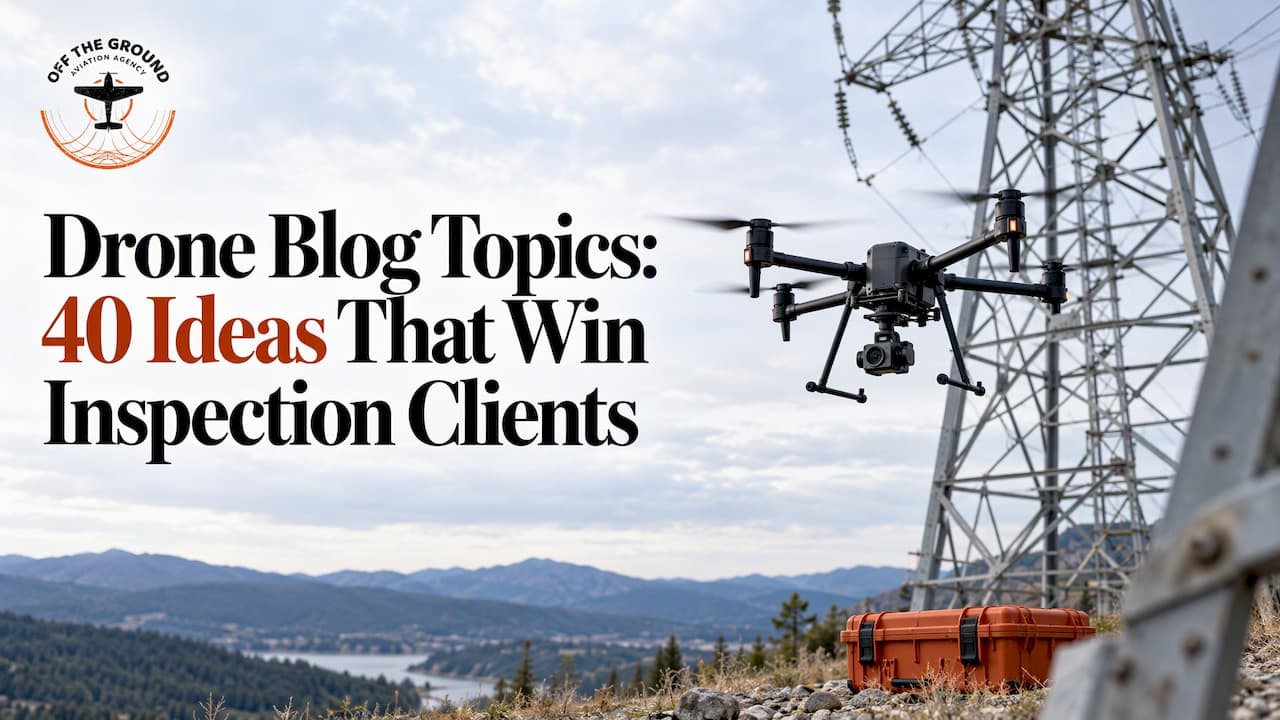
The best drone blog topics for a business are the questions your buyers ask before they hire: how a power line inspection works, what a survey deliverable looks like, what the rules require, and what a project cost and returned. Hobby topics like gear reviews and travel footage bring readers, but not contracts. Below are 40 topics grouped by what they do for a commercial UAV company, plus how to write them without overclaiming.
TL;DR
- Write for the person who signs the contract (an engineer, a utility procurement lead, a construction manager), not for drone enthusiasts.
- Build topics around four buckets: industry applications, rules and risk, technology, and proof of results.
- Name the jurisdiction on every regulatory post, and link the regulator’s own page.
- Separate what your data observed from what it diagnosed. That one habit protects your credibility.
- Publish fewer, deeper posts tied to a service page, rather than a daily stream of news rewrites.
Table of Contents
- Why most drone blogs bring the wrong readers
- Topics built around industry applications
- Topics about rules, permissions and risk
- Topics that explain how the work is done
- Topics about technology and industry trends
- Topics that show proof
- Match the topic to the buyer’s stage
- Our perspective: write fewer posts, closer to the sale
- Turning the list into a plan
- Where we can help
- FAQ
- Sources
Why most drone blogs bring the wrong readers
Search for drone blog ideas and you will find magazines, gear roundups, forums and news sites. Those pages serve people who own or want a drone. If you sell inspection, survey, mapping or spraying services, that audience is not your buyer.
Your buyer asks different things. A utility asset manager wants to know if drone inspection can replace a climb. A construction manager wants monthly stockpile volumes without a survey crew on site. A farm operator wants to know when imagery can flag a problem. A procurement lead wants to confirm you are authorized to fly where they need you.
So the filter for any topic is simple: would someone with budget and a problem search for this, and would your answer make them think of you first? If the answer is no, it is entertainment, not marketing.
Topics built around industry applications
This is the core of a commercial drone blog. Each application is a customer problem, and each problem deserves its own post. A useful rule: a real drone application involves a specific sensor, a data-processing workflow and a structured output that supports a decision, not just attractive imagery.

Energy and utilities
Utility work is rich with topics because the alternatives (climbing, helicopters, shutdowns) are costly or hazardous. Outdoor inspection drones are used on transmission lines, pipelines, telecom towers, wind turbines, solar farms and transportation infrastructure, and that market is projected to grow from $300.0 million in 2025 to $601.4 million by 2035. That growth means more buyers learning the vocabulary right now.
Topic ideas:
- How a drone transmission line inspection works, from flight plan to defect report
- Thermal inspection of solar farms: what a hot spot tells you and what it does not
- Wind turbine blade inspection without rope access: what you get back
- Pipeline right-of-way patrol: how often, at what resolution, with what deliverables
- Storm damage assessment: what to expect in the first 72 hours after an event
For the marketing angle behind these, see our guide to what utility procurement teams search for.
Construction and mapping
- Progress tracking: how monthly flights replace walk-throughs
- Earthwork and stockpile volumes: how drone surveys are calculated
- Photogrammetry vs. LiDAR for site surveys: which fits which job
- Ground control points: why accuracy depends on what is on the ground
- How to read an orthomosaic and a point cloud if you are not a surveyor
Agriculture
- Crop health monitoring: what multispectral imagery shows and when to fly
- Targeted spraying: what drone application can and cannot replace
- Scouting versus sensing: when a walk of the field is still the right call
- Turning field imagery into a prescription map
- How drone data fits into an agronomist’s workflow
The last two matter most. Agronomists are the gatekeepers of many farm decisions, and a post that speaks their language earns trust faster than a general overview. Our aerial survey and agronomy case study shows how that positioning looks on a real site.
Airports, public safety and real estate
The FAA has described airport use cases that include obstruction analysis, perimeter fence and pavement inspection, foreign-object-debris detection, wildlife-hazard management and lighting inspection. Each of those is a post for operators who serve airports.
- Pavement inspection by drone: what defects are visible and what needs a ground check
- Roof and facade inspection for insurers and property managers
- Emergency response mapping: what responders need from a drone team
- Real estate and commercial property imaging: what makes it usable beyond marketing photos
- Search and rescue with thermal sensing: capabilities and limits
Topics about rules, permissions and risk
Regulation posts do two jobs. They rank for the questions buyers type, and they answer the quiet question every procurement team has: are you allowed to do this safely and legally?
Two rules for these posts. First, name the country in the title or first line. A U.S. rule is not a global rule. Second, link the regulator, not a summary of it.
- What a Part 107 remote pilot certificate covers, and what it does not. In the U.S., you need a Remote Pilot Certificate from the FAA to fly under the Small UAS Rule.
- How waivers work in practice. An FAA certificate of waiver spells out conditions. One published waiver, for example, requires that operations over non-participants or moving vehicles be transitory, with loitering or hovering prohibited. Explaining what conditions like that mean for a client’s site is a strong topic.
- Beyond visual line of sight: what the proposed rules mean for your clients. The FAA’s BVLOS fact sheet says drones operated under the proposed Part 108 would need lighting and broadcast Remote ID. Mark these as proposed and tell readers to check the current status.
- Privacy and data protection for drone data. In the EU, the aviation safety agency describes a data protection impact assessment as mapping data flows, weighing necessity and proportionality, assessing risks and identifying safeguards.
- Pre-flight risk assessment: how your team plans a job near people, roads or airspace
- Insurance and what clients should ask for in a certificate
- What a UK or Canadian operator needs that a U.S. one does not (write it only if you serve those markets)
A UK academic study of the commercial drone industry highlights flight-planning apps, visibility and community engagement as practices operators use. It also records industry voices urging operators to think like an aviator. That attitude, borrowed from manned aviation, is the tone buyers want to see.
We go deeper on this in what procurement teams read about drone regulation.
Topics that explain how the work is done
The most underused category. Buyers cannot judge a drone service they do not understand, so a clear walkthrough of your process is both education and a sales tool.
A solid inspection post follows the order of the job: the objective, the data required, sensor and mission planning, capture conditions, quality checks, analysis, and deliverables. Publish each stage as a post or as sections of one pillar page.
- What goes into a drone inspection scope of work
- Choosing a sensor: visual, thermal, multispectral or LiDAR, and why
- Weather, battery endurance and authorization: the three limits on any job. Plain talk about constraints reads as honest, not weak.
- Quality checks before delivery: overlap, georeferencing, checkpoints
- What is in a processing report and how a client should read it
- Deliverables explained: report, orthomosaic, 3D model, annotated defect log
Keep observation and diagnosis apart
One careful habit separates credible posts from hype. Say what the imagery shows, at which asset and location, and say what it does not show. A crack in a photo is an observation. The root cause and the repair are an engineer’s call. Writing it that way tells an engineering client you know where your work ends and theirs begins.

The same discipline applies to numbers. Never publish a savings figure, accuracy figure or time reduction unless it comes from your own documented projects or a source you can link. “Up to 90% cheaper” with no origin is the fastest way to lose a skeptical reader.
Topics about technology and industry trends
Trend posts are timely and easy to link to, but they bring the wrong readers unless you tie them to a buyer decision. Ask what the trend changes for someone hiring a drone service.
Current technology themes include AI and autonomy, LiDAR, thermal sensing, VTOL and eVTOL aircraft, and airspace management, all tracked in monthly drone technology roundups.
- What LiDAR adds that photogrammetry cannot (vegetation, wires, bare earth)
- Autonomous inspection: what “autonomous” means and where a pilot still decides
- Thermal imaging: temperature differences, emissivity and false positives
- Long-range and VTOL platforms: when do they change a project’s economics?
- How a large utility’s drone program shapes what contractors are asked for
On the last one, a U.S. industry white paper describes Dominion Energy using autonomous drones to inspect solar panels with thermal imaging, assess storm damage and inspect nuclear plants. Large buyers set expectations that smaller buyers follow.
A caution on news-driven posts: many trend stories involve defense and conflict. Unless you serve that market, skip them. A commercial inspection buyer does not need your take on battlefield drones.
Topics that show proof
- A before-and-after case study with measurable results: the problem, the method, the data, the outcome, and what the client did with it
- A project retrospective: what went wrong, what you changed
Proof is the highest-converting content a drone company can publish, and the hardest to fake. Get written permission from the client, state the scope honestly, and quantify only what you measured. Our walkthrough on case study content that wins drone inspection work covers structure and approvals.
Match the topic to the buyer’s stage
A content calendar works better when each post has a job. Use this as a planning grid.
| Buyer stage | What they ask | Post type | Example from the list |
|---|---|---|---|
| Problem aware | Is there a better way to inspect this? | Application explainer | #1, #6, #11 |
| Solution aware | What does a drone deliver? | Process and deliverables | #28, #32, #33 |
| Risk check | Can you do it legally and safely? | Regulation and safety | #21, #22, #25 |
| Vendor comparison | Why you rather than a crew or competitor? | Case study, scope guide | #39, #40 |
Start with the bottom two rows if your pipeline is thin. They are closest to a signed contract. Add the top rows once those exist, to widen the funnel. For how posts feed the rest of a pipeline, see our piece on building a B2B drone lead pipeline.
Our perspective: write fewer posts, closer to the sale
We come at this as aviators first. Joey Pehrson is a commercial rotorcraft pilot and former flight school general manager, and we work only with aviation businesses, so we see how aviation buyers behave before they pick up the phone. They read slowly, compare quietly, and check credentials before anything else.
That changes what we tell drone operators. Do not chase the traffic of a drone magazine. A post that three engineers read before an RFP is worth more than one that a thousand hobbyists skim. Pick eight to twelve topics from the list above, make each the best page on the web for its question, tie each to a service page, and update them when rules or your own capabilities change.
We also tell operators to treat regulation and safety as marketing assets. In aviation, showing that you understand risk is a sales argument. Say what your limits are. Buyers trust operators who do.
— Joey Pehrson
Turning the list into a plan
Even good topics fail without a system around them. Here is a workable setup.
- Choose a pillar per service. If you offer utility inspection, one deep guide anchors everything else. Supporting posts link to it and back.
- Write from real jobs. Pull questions from calls, RFPs and emails. Those are your keywords, in the buyer’s words.
- Add a human author. A named pilot or analyst with a Part 107 certificate (or your country’s equivalent) reads as more trustworthy than an unsigned page.
- Include a next step. End each post with a specific offer: a sample report, a scoping call, a site assessment.
- Distribute where buyers are. Engineers and procurement leads live on LinkedIn. Our LinkedIn strategy for drone service companies shows how.
- Review quarterly. Retire posts that cite outdated rules. A regulation post that is a year old can be worse than none.
For the bigger picture beyond the blog, our complete guide to marketing a drone business in 2026 covers channels and budget.
Where we can help
If you would rather not write all of this yourself, our content marketing service plans and produces aviation-specific articles for drone operators, built around the buyer stages above. Content Marketing has no published price, so we scope it with you. If search visibility is the bigger gap, aviation SEO starts from $1,500 per month, and the full plan list is on our pricing page.
Because we only work in aviation, you skip the months a general agency spends learning what a Part 107 waiver is or why a utility asks for your insurance. See how we approach the sector on our drone marketing page.
FAQ
How often should a drone company publish blog posts?
Two strong posts a month beat daily thin ones. Commercial buyers search for narrow questions, so depth and accuracy matter more than volume. Once your core topics are covered, shift your time to updating them.
Should a drone business write about drone news and gear reviews?
Only rarely, and only with a clear buyer angle. News and reviews attract hobbyists and drone magazines already own that audience. A post on a new sensor is worth writing if it explains what it changes for an inspection client.
How do I write about regulations without giving legal advice?
Name the country, link the regulator’s own page, and describe what the rule says rather than what a client should do. Mark proposed rules as proposed. Send readers to the regulator or a qualified aviation attorney for their specific situation.
Can I use case studies if clients will not let me name them?
Yes. Anonymize the client, describe the asset type and region, and keep the measured results. Get written approval for what you publish. An anonymous case study with real numbers beats a named one with vague claims.
What is the easiest first post to write?
A walkthrough of your own inspection or survey process, from scope to deliverable. You already know it, buyers need it, and it shows exactly what they get for their money.
Sources
- Outdoor Inspection Drone Market Analysis and Forecast, GII Research
- FAA UAS Airport Applications Research Update, via ICAO
- Become a Certificated Remote Pilot, FAA
- Certificate of Waiver and Authorization, FAA
- Beyond Visual Line of Sight Fact Sheet, FAA
- Data Protection Impact Assessment, EASA
- UK Commercial Drone Industry, University of Reading
- Drone Technology roundup, DroneXL
- The Drone Revolution is Hovering, Jabil white paper
Recommended
Aviation Marketing Notes
One operator-shaped read per week. No agency newsletter padding.
Joey shares the patterns we see across flight school, charter, MRO, and FBO clients. Practical. Aviation-specific. Unsubscribe whenever.