Social Media for Charter Flights: What Brings Inquiries
How charter operators and brokers use Instagram, LinkedIn and paid social to win qualified inquiries, protect client privacy, and budget ad spend.
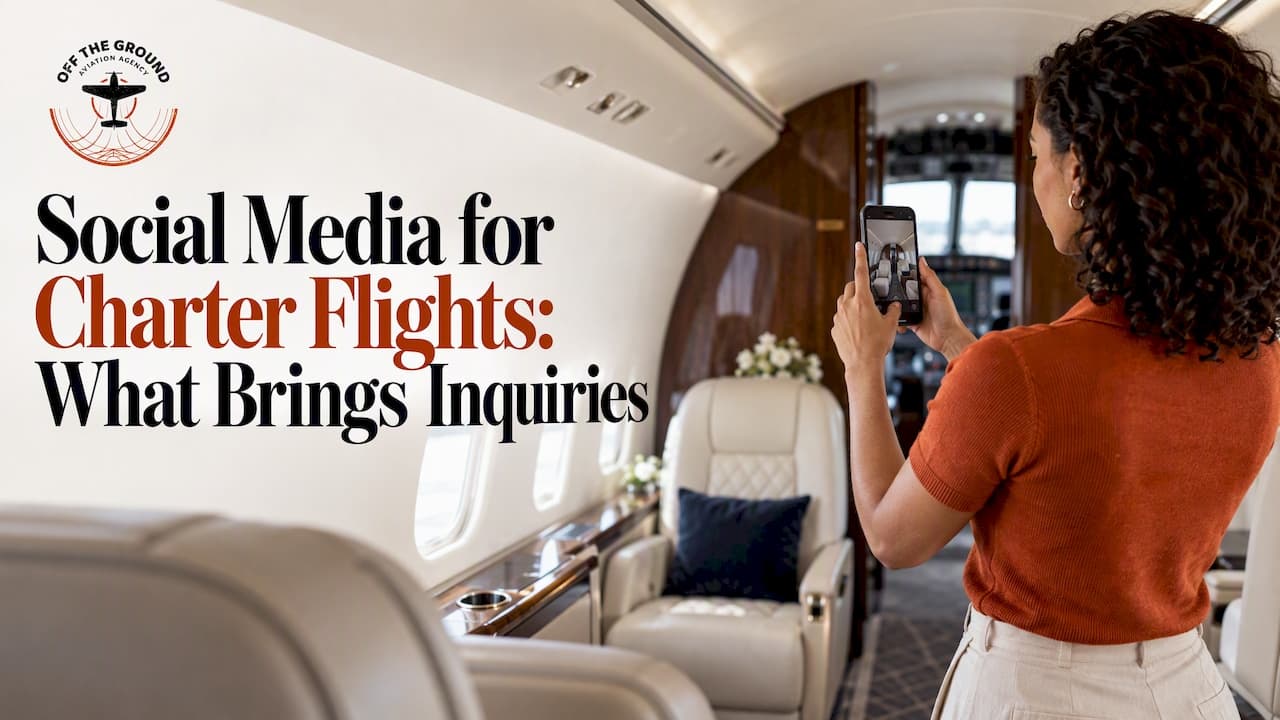
Social media sells charter flights when it does three jobs: it shows buyers that your aircraft and crews are real, it answers the planning questions they have before they ever request a quote, and it routes them to a fast, simple inquiry path. It rarely works as a booking channel on its own. Treat it as the trust layer that sits in front of your quote form, and measure it by qualified inquiries, not likes.
This guide is written for charter operators, brokers and aircraft managers. It covers which platforms fit, what to post (and what never to post), what paid social costs, and how to tell whether any of it is producing flights.
TL;DR
- Instagram builds trust with leisure and executive charter buyers, LinkedIn reaches corporate flight departments and travel managers, and both should point to one clear quote path.
- Educational posts about airports, aircraft matching and trip planning outperform sales pitches, according to a charter brokerage’s own account of its approach.
- Never post passenger names, manifests or live trip details. Get operator approval for aircraft photos and keep price claims compliant with DOT rules.
- Our management fee for paid social starts at $750 per month, on top of the ad budget itself. Judge it by cost per qualified inquiry, not cost per click.
- Answer every comment and message quickly. A fast reply is often the cheapest conversion lift you have.
Table of Contents
- Who actually buys charter from social media
- Choosing platforms for a charter business
- What to post: teach, don’t pitch
- Protecting client privacy and staying compliant
- What does it cost to advertise charter flights on social media?
- Build the path from post to quote
- Measuring whether social media produces charter inquiries
- Our perspective: social proof first, ads second
- How we can help
- FAQ
- Sources
Who actually buys charter from social media
The search results for this topic show two different conversations. One is consumer chatter: influencers, jet-travel aspiration, debates over who gets to fly private. The other is business: how a broker or operator turns attention into a signed trip. Only the second one pays your bills.
Your buyers fall into a few groups, and they behave differently:
- Leisure and family travelers, often first-time charterers, who browse Instagram and YouTube and want reassurance about safety, cabins and process.
- Executive assistants and travel managers, who search on Google and check LinkedIn to see whether a company looks established.
- Corporate flight departments and high-net-worth owners, who care about fleet, certification and reputation more than glossy cabin shots.
- Other brokers, who may route trips to an operator they have seen performing well.
A first-time charterer rarely clicks a post and books that afternoon. They follow, watch, search your name, visit your site, then ask for a quote. That path is why your social profiles, your website and your quote form have to tell the same story. Our guide on why an online presence matters for charter operations covers the website side of that chain.
Choosing platforms for a charter business
Do not try to be everywhere. Pick one primary channel and one supporting channel, and do them well.
| Platform | Best for | What works | Watch out for |
|---|---|---|---|
| Leisure and executive buyers, brand trust | Short video of real operations, aircraft-matching explainers, destination and airport content | Privacy slips, stock-photo look, unanswered comments | |
| Corporate flight departments, travel managers, fleet and management contracts | Safety culture, certification news, crew profiles, sector commentary | Posting like a consumer brand | |
| YouTube | Explaining cabins, process and routes in depth | Aircraft walk-throughs, “how a charter works” videos | Production cost without a plan for distribution |
| Local retargeting, community and event audiences | Paid retargeting of site visitors | Organic reach is limited for most business pages |
For B2B contracts such as aircraft management or corporate flight-department work, LinkedIn deserves more attention than most operators give it. We go deeper in our piece on LinkedIn marketing for aviation B2B. If you also run airline-style or FBO operations, see our overview of social media marketing for airlines, FBOs and charter operators.
What to post: teach, don’t pitch
Charter is confusing to people who have never done it. Why is one aircraft right for a trip and another wrong? Why does a smaller airport save an hour? What happens at the FBO? Charter brokerage Amalfi Jets describes its Instagram approach as educating viewers on planning factors like airport selection and aircraft matching instead of treating the feed as a place for simple sales pitches. The same account argues that this transparency helps first-time charterers understand why different missions call for different aircraft, which builds trust and reduces uncertainty.
That matches what we see across aviation accounts. Content that earns inquiries tends to fall into these buckets:
- Aircraft-matching explainers. “Eight passengers, two hours, short runway: here is why we would not send a light jet.” Real reasoning shows expertise.
- Airport and FBO guides. Which field saves ground time near a popular destination, and what the handoff looks like.
- Behind the operation. Crew prep, maintenance, catering, ground handling. It reassures buyers about the parts of charter they cannot see.
- Process walk-throughs. From quote to wheels-up, in plain steps, with no jargon left unexplained.
- Empty-leg and availability notices, where your terms allow and your pricing claims are compliant (more on that below).
- Answers to real questions. Pull them from your quote requests and call logs. If three people asked about pets, make a post.
Flight schools and drone operators have their own playbooks, since their buyers are students and enterprise clients rather than charterers. For schools, see our 30 social media content ideas for flight schools.
Protecting client privacy and staying compliant
Charter clients pay for discretion. A single careless post can cost you a client and a reputation.
- No passenger identifiers. No names, manifests, tail-number-plus-timestamp combinations, or real-time location of a trip in progress. Post trips after the fact, and only with written consent.
- Operator-approved imagery. If you are a broker, use photos of aircraft you are actually authorized to offer, cleared by the operator. Do not show a cabin you cannot deliver.
- No guarantees you cannot back up. Safety, availability and pricing language should match what your certificate holder and your quotes actually support.
- Price advertising has rules. The U.S. Department of Transportation maintains a hub of aviation advertising rules and guidance, including 14 CFR 399.84 on price advertising and guidance on advertising air fares on social media. Read it before you post any fare, “from” price or empty-leg deal, and have your counsel confirm how it applies to your operation, whether you are an operator or a broker.
We also work with operators outside the U.S., where the rules differ by authority. Check the regulator in your own country before copying any U.S. practice.
What does it cost to advertise charter flights on social media?
Two different costs get mixed up in this search, so separate them.
The cost of the flight itself. Buyers sometimes ask what an hour of charter costs, and your ads should never contradict the real answer. One charter brokerage’s 2026 guide puts hourly charter pricing from roughly $1,500 to $3,000 for turboprops and very light jets, $2,500 to $4,000 for light jets, and $4,000 to $8,000 for midsize jets, rising to $8,500 to $20,000 or more for heavy and ultra-long-range aircraft. The total depends on far more than category: positioning, fees, routing and demand all move it. So quote ranges carefully in ads and let the quote itself carry the exact number.
The cost of advertising it. This is the number that matters to your marketing budget, and it has three parts:
- Media spend. What you pay Meta or LinkedIn. Cost per click and cost per lead vary widely by audience, season, creative and country, so published averages from other industries are a weak guide. Charter is a small, high-value audience. Expect to pay more per lead than a consumer brand and to need far fewer leads.
- Management. Someone has to build audiences, creative and tracking, and review lead quality weekly. Our Meta and social ads management is $750 per month. Google Ads management on additional budget is $200 per month per $1K of spend, and our PPC and advertising service starts from $3,000 per month.
- Creative. Real footage beats stock. A half-day video production session with us is $2,500, and one session can supply months of short clips.
The useful question is not what a click costs. It is what you can pay for a qualified inquiry given your average trip margin and close rate. If a typical booking earns you a four-figure margin and one inquiry in five closes, you can afford a much higher cost per inquiry than a generic benchmark suggests. Do that arithmetic before you set a budget.
Targeting the right people
Broad interest targeting (“luxury travel,” “private jets”) pulls in aspirational viewers who will never book. Better inputs are your own first-party lists: past customers, quote requesters and site visitors, then lookalikes built from them. On LinkedIn, target by job title, company size and industry for flight-department and management work. Always exclude existing clients and job seekers.
Build the path from post to quote
Most wasted social spend leaks after the click. Check these before you spend a dollar:
- A dedicated landing page that matches the ad’s promise, not your home page.
- A short quote form. Route, date, passenger count and contact. Every extra field costs you inquiries, but one or two qualifying fields (such as trip type) protect your sales team’s time.
- A visible phone number and a click-to-message option for buyers who prefer to talk.
- Speed. Reply in minutes during business hours. Charter buyers often request several quotes at once, and the first credible answer tends to win the conversation.
- Quoting that is not painful. Slow, manual quotes lose trips. Our charter quote checklist is a 30-point audit of this stage, and our FareBuild case study shows how we approached charter quoting software.
While you are at it, reply to comments. A study published by an analytics vendor found that only about one in four customer questions posted in comments on airline public posts received a response. Even if that is airline data rather than charter data, the lesson transfers: an unanswered public question is a public sign that nobody is home.
Measuring whether social media produces charter inquiries
Likes and follower counts do not pay for fuel. Track these instead:
| Metric | Why it matters |
|---|---|
| Quote requests by source | Shows which platform and campaign actually generate inquiries |
| Cost per qualified inquiry | Ties spend to leads your team would genuinely pursue |
| Inquiry-to-booking rate by source | Reveals which channels bring buyers, not browsers |
| Revenue or margin per source | The only number that settles a budget argument |
| Response time | Predicts whether a lead survives the first hour |
Define “qualified” in writing: a real route, a realistic date, a reachable contact, a trip in your fleet’s range. LinkedIn’s own reporting schema treats a qualified lead as one deemed more likely to become a customer based on engagement and fit, and offers a cost-per-qualified-lead metric alongside conversion and cost data. Whatever platform you use, do the same: send offline outcomes (booked, lost, not a fit) back into your ad account so it learns from real results, not form fills.
For wider benchmarks across the sector, see our State of Aviation Marketing 2026.
Our perspective: social proof first, ads second
We are commercial pilots and aviation operators, and we have sat on both sides of this. The mistake we see most often is operators buying reach before they have earned belief. A buyer who is about to spend thousands of dollars on a flight checks you out. They look at your Instagram, your site and your search results, and they want the same picture from each.

So we start with the foundation: a site that speaks the buyer’s language, a quote path with no friction, and a few months of honest, specific content. Then we add paid social to amplify what already converts. Social supports search; it does not replace it. People who see you on Instagram will later search your name, and people who search “charter flights near me” will check your feed before they call. That is why our work on private aviation SEO and social content is planned together, and why we report on enquiries and quotes rather than impressions.
If you remember one thing: show the work, protect the client, answer fast.
— Joey Pehrson
How we can help
If you want this built for you, we run aviation-only marketing for charter operators, brokers, aircraft managers, flight schools and other aviation businesses. Monthly plans run from Launch Pad at $1,500 per month to Altitude at $3,000, Glass Cockpit at $5,500 and Flight Director from $8,500; content, social ads, video and CRM follow-up can be added as needed. See current terms on our pricing page, or read how charter marketing drives direct bookings.
FAQ
Is Instagram worth it for a private jet charter company?
Yes, as a trust and discovery channel, especially for leisure and executive buyers. It rarely closes bookings directly, so connect every profile to a landing page and quote form, and measure inquiries rather than engagement.
Can I post empty-leg deals and prices on social media?
You can, but price advertising is regulated. The U.S. DOT advertising page compiles the rules, including 14 CFR 399.84 and guidance on advertising fares on social media. Confirm with aviation counsel how they apply to you as an operator or broker before posting any fare.
How much should a charter company spend on social ads?
Work backward from your average trip margin, your close rate and the cost per qualified inquiry you can afford. Starting small, testing one audience and one offer, and scaling only what produces booked trips is safer than committing a large budget up front. Our social ads management starts at $750 per month plus ad spend.
How do I keep client details private on social media?
Never post names, manifests or live trip details, and get written consent before sharing any client-related content, even after the flight. Use operator-approved aircraft imagery and avoid combinations of tail number, route and timing that could identify a passenger.
Sources
- Amalfi Jets: Instagram and social aviation brand
- Amalfi Jets: private jet charter cost per hour
- U.S. Department of Transportation: aviation advertising
- LinkedIn Ads reporting metrics
Recommended
Aviation Marketing Notes
One operator-shaped read per week. No agency newsletter padding.
Joey shares the patterns we see across flight school, charter, MRO, and FBO clients. Practical. Aviation-specific. Unsubscribe whenever.